
24-Oct-2026
Anshika
Sekta ya viwanda nchini Kenya—kutoka kwa uzalishaji wa plastiki hadi chuma, mpira, na nguo—inahitaji vifaa vya kuaminika vya kupima nguvu na ubora wa malighafi. UTM machine Kenya ni chombo muhimu kinachotumika kupima nguvu ya kunyoosha (tensile), mgandamizo, na uinamishaji wa vifaa mbalimbali. Iwapo unatafuta universal testing machine manufacturer in Kenya anayeaminika au UTM material testing machine Kenya yenye teknolojia ya kisasa ya kidijitali, Presto Instruments ina suluhisho linalofaa kiwanda na maabara yako.
Kenya's industrial sector—from plastics manufacturing to metals, rubber, and textiles—needs dependable equipment to test the strength and quality of raw materials. A UTM machine in Kenya is an essential instrument used to measure the tensile, compressive, and flexural strength of various materials. If you are looking for a trusted universal testing machine manufacturer in Kenya or a UTM material testing machine in Kenya built with modern digital technology, Presto Instruments has the right solution for your factory and laboratory.
Presto Instruments is one of the universal testing machine manufacturers in Kenya. It is also one of the universal testing machine suppliers in Kenya. The company offers UTM tensile testing machines for plastics, metals, rubber, textiles, and composites. Presto provides manufacturing and QC laboratories in Nairobi, Mombasa, Kisumu, and Eldoret. Presto’s UTM testing machines for clients work by applying a controlled tensile, compressive, or flexural load to a clamped test specimen until it breaks. The machine measures the load and elongation to create a stress-strain curve. From this curve, the tensile strength, yield strength, elongation, and modulus of elasticity are determined. The Presto UTM material testing machine for the market has a digital load indicator with a strain gauge load cell. It also has an LED display and interchangeable grippers for round and flexible specimens. The following information covers what a UTM tests, how it works, the types of grippers and standards involved, and the price of UTM machines in Kenya.
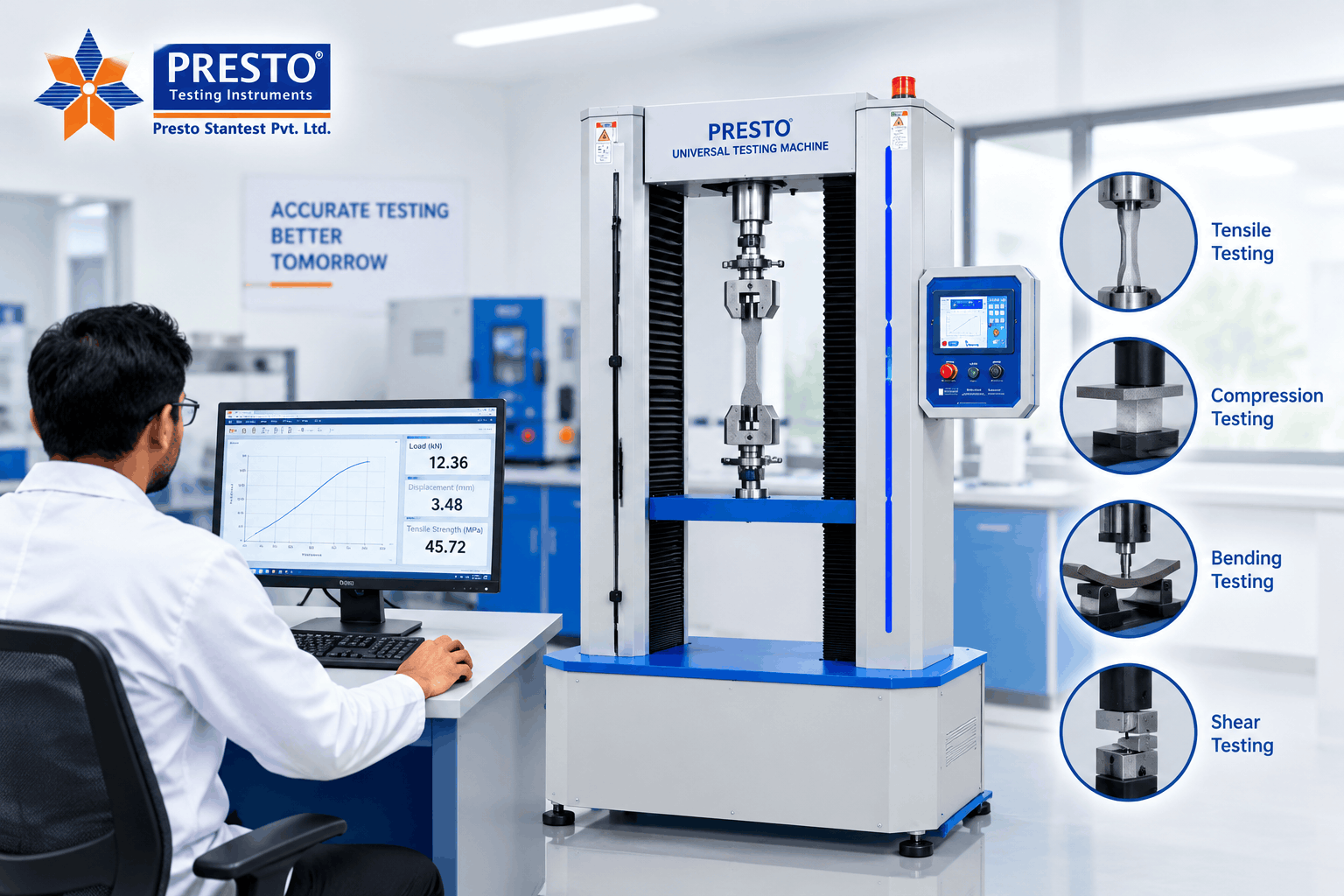
A universal testing machine is an apparatus employed in a laboratory to aid us in gaining knowledge about how different materials respond when stress is applied to them. A Universal Testing Machine elongates, compresses, bends, and even rotates the material until it breaks.
The term 'universal' in this type of machine refers to the fact that one machine can perform tests for both tension and compression, among other types of stress. It does this by switching the fixture or gripper that holds the material sample.
The universal testing machine can be considered an important tool in quality laboratories of enterprises producing plastics, metals, rubber, textiles, and building materials. The information received from the universal testing machine about material behavior under stress conditions is very valuable for ensuring the safety and reliability of the material before it enters the final product.
A universal testing machine measures how a material reacts mechanically when it is given more force. It collects information that helps figure out features of the material, including:
This information is plotted on a stress-strain curve, providing engineers and quality control professionals with a full profile of the performance of the material up until the point of failure.
Presto Instruments is a specialist maker and exporter of material testing equipment. Presto offers machines that are reliable and easy to operate. They support customers who make plastic, metal, rubber, and textile products, as well as quality‑control laboratories. Presto Instruments ships these UTM machines to Kenya and to markets around the world. Presto also provides support and after‑sales service. Explore the full product details on the Presto Tensile Strength Testing Machine product page.
|
Presto Universal Testing Machine — Key Features |
Details |
|
Display type |
Digital / LED display for load and elongation. |
|
Capacity range |
250 kgf / 500 kgf / 1000 kgf and higher-capacity models are available. |
|
Load measurement |
Strain gauge-based load cell with digital load indicator. |
|
Elongation measurement |
Digital extensometer or encoder system. |
|
Drive system |
Geared motor with variable speed control |
|
Crosshead travel |
Approx. 900 mm (model-dependent) |
|
Accuracy |
±1% of full-scale value |
A key strength of the UTM is the ability to test different material types. This can be done simply by swapping the gripper or fixture used to hold the specimen. Used gripper and fixture types include:
|
Gripper / Fixture Type |
Best Suited For |
|
Flat-face (jaw) grips |
Sheets, plastic films, metal strips, and flat specimens. |
|
Wedge-action grips |
Metals, plastics, and elastomers requiring self-tightening, slip-resistant clamping. |
|
Pneumatic grips |
High-volume testing of films, foils, textiles, and thin, sensitive materials. |
|
Vice-type mechanical grips |
Rigid materials such as metal bars, rods, and plastic profiles. |
|
Capstan/roller grips |
Yarns, threads, ropes, cords, and wires that would slip in flat jaws. |
|
Rubber and elastomer grips |
Highly stretchable specimens such as rubber, gaskets, and seals. |
|
Compression platens |
Compression testing of blocks, cushioning materials, and packaging. |
The choice of gripper in relation to the specimen is crucial. Using the wrong gripper may cause slipping, which may damage the specimen. The slipping may also create a failure point. This particular failure point is not true to the strength of the specimen.
|
Step |
Test Procedure |
|
1. Gripper Selection and Setup |
Choose and fit the right gripper or fixture depending on the specimen and test to be performed, for example, tension, compression, or flexure. |
|
2. Specimen Mounting |
Ensure that the specimen is well-secured in the grips to ensure its alignment and straightness. |
|
3. System Zeroing |
Zero out the readings for force and displacement prior to beginning the experiment. |
|
4. Applying the Load |
Adjust the speed of the machine to exert either tensile, compressive, or bending stress on the test piece. |
|
5. Data Acquisition |
Measurements of force and movement are constantly taken by sensors. |
|
6. Specimen Failure |
Conduct the test until there is breakage, bending, deformation, or test limitation of the specimen. |
|
7. Stress-Strain Curve |
Construct a stress-strain or load-deformation graph using the values obtained from the force and displacement measurements. |
|
8. Result Calculation |
Determine various values, for instance, maximum force, elongation, deformation, and stiffness based on the experiment results. |
|
9. Reporting |
Document the findings for the purpose of quality control, comparative studies, product development, or any other purpose. |
UTM testing is important for checking the quality of materials and helping create products for many real reasons:
A universal testing machine is used across industries:
The testing machines used for universal applications adhere to standards such as ASTM E4, ASTM D638-01, ASTM A370, and ISO 7500-1. They provide procedures that should be followed in order to conduct the tests, including specimen sizes and ways of computing results. For Kenyan manufacturers and exporters, sticking to them ensures the validity of their results both locally and internationally. Do not know which standard applies to your product or industry? Just contact us, and we will configure your testing machine accordingly.
Some factors may affect the precision of UTM tests, and some of these include the following that need to be controlled by Kenyan QC technologists:
|
Factor |
How It Affects Results |
|
Gripper selection |
Using the wrong gripper for a specimen type on a UTM tensile testing machine can cause slippage or premature failure at the grip, giving a false low reading. |
|
Specimen alignment |
Misaligned specimens in a universal testing machine introduce bending stress that distorts the true tensile or compressive result. |
|
Test speed (crosshead speed) |
Testing at an inconsistent or non-standard speed on a UTM material testing machine produces results that cannot be compared between batches. |
|
Specimen preparation |
Rough edges, nicks, or inconsistent dimensions on the specimen create stress concentration points that cause premature failure. |
|
Load cell calibration |
A poorly calibrated load cell on any UTM testing equipment produces inaccurate force readings regardless of how well the test is otherwise conducted. |
|
Elongation measurement accuracy |
An improperly attached or calibrated extensometer on a UTM machine leads to incorrect elongation and modulus values. |
When evaluating a UTM machine in Kenya, consider the following before you invest:
The UTM machine price in Kenya depends on several configuration and service factors:
If you want a price that really matches the types of materials you have and the amount of testing you need, the best thing to do is ask for a quote from the sales team at Presto Instruments. Do not rely on the estimates you find online. Those estimates are not based on your situation. They do not take into account your materials or your testing goals. So instead, reach out to the sales team at Presto Instruments. Request a quote. After receiving your quote, compare it against your materials list. In this manner, you will be able to see its suitability for your needs. The quote will show the testing requirements for your project. It will be tailored to what you need.
Je, uko tayari kuboresha maabara yako ya udhibiti wa ubora kwa UTM machine Kenya inayotegemewa na yenye ubora wa hali ya juu? Wasiliana na Presto Instruments leo kupata bei bora, maelezo ya kiufundi, na maonyesho ya bure ya mashine. Piga simu +91 9210903903 au tuma barua pepe response@prestogroup.com. Timu yetu iko tayari kukusaidia kuchagua universal testing machine Kenya inayofaa mahitaji yako ya uzalishaji na maabara.
Are you ready to upgrade your quality control lab with a UTM machine in Kenya that is dependable and built to a high standard of quality? Contact Presto Instruments today for the best price, technical specifications, and a free machine demonstration. Call +91 9210903903 or email response@prestogroup.com. Our team is ready to help you choose the right universal testing machine in Kenya for your production and laboratory needs.
Visit: Presto Tensile Strength Testing Machine product page. Phone: +91 9210903903. Email: response@prestogroup.com
A universal testing machine is one of the most versatile and essential instruments in any material testing lab, and for Kenyan manufacturers working with plastics, metals, rubber, and textiles, investing in a reliable universal testing machine is a direct investment in product quality, safety, and customer confidence. Many manufacturers know how a universal testing machine can change the game, and Presto Instruments, a trusted universal testing machine manufacturer and supplier in Kenya, offers digital universal testing machines with a full range of grippers, designed for accuracy and durability on demanding factory floors and in busy quality control laboratories alike; whether you run a plastics plant in Nairobi, a metal fabrication unit in Mombasa, or a textile mill near Kisumu, choosing the right universal testing machine ensures every material entering the production line performs exactly as expected.
1. What is a universal testing machine used for in Kenya?
A universal testing machine is used by manufacturers in Kenya in the plastics, metals, rubber, and textiles industries. Many factories rely on a testing machine to check how strong materials are. The universal testing machine measures tensile strength, compressive strength, and flexural strength. Using a testing machine helps to make sure that materials are of good quality before they are turned into products or shipped for export.
2. What types of grippers does a UTM machine use?
A UTM machine can use flat‑face grips, wedge‑action grips, pneumatic grips, vice‑type mechanical grips, capstan/roller grips, rubber grips, compression platens, and bend fixtures. When using a UTM machine, the choice of each grip or fixture depends on the specimen type and the test that is being performed.
3. What is the UTM machine price in Kenya?
The universal testing machine price in Kenya depends on the load capacity, whether the UTM machine is digital or computerized, the type of gripper accessories that the UTM machine needs, and import and logistics costs. For a quotation, contact Presto Instruments directly.
4. Can one universal testing machine test multiple types of materials?
Yes, a Presto universal testing machine can test metals, plastics, rubber, textiles, and composites. The Presto universal testing machine can do this by changing the gripper or fixture that holds the specimen. The Presto universal testing machine adjusts to each material by using the grip or fixture. This makes the Presto universal testing machine very flexible for testing different kinds of materials. The same Presto universal testing machine can handle tests without needing a replacement and is designed to be adaptable for testing needs.
5. Who is a reliable universal testing machine manufacturer and supplier serving Kenya?
Presto Instruments is a known name when it comes to making and selling universal testing machines in Kenya. The company also ships its testing equipment to other countries. Presto Instruments designs models that are made to suit the needs of various manufacturing industries in Kenya.
6. What is the difference between a UTM and a tensile testing machine?
A tensile testing machine usually only does tension tests. A universal testing machine, or UTM, can do tension tests, compression tests, and flexural tests on the same machine. It does this by changing the gripper or the fixture that holds the sample.
7. Why do test results vary between UTM test batches?
Variations usually happen because of differences in the way the gripper is chosen. Variations usually happen because of how the sample is lined up. Variations usually happen because of how the test is done. Variations usually happen because of how the sample is prepared. Variations usually happen because of whether the equipment is properly calibrated. All of these things should be kept under control. All of these things should be watched closely during testing.
Elevate your quality assurance process to new heights
At Presto, we take pride in being Global manufacturers of Laboratory Testing Instruments for different industries.