
13-Apr-2026
Presto Instruments
Carton failures rarely originate from visible defects—they result from structural weaknesses under multidirectional stress. In high-stack warehouses, humid coastal exports, or long-haul container shipments to the Middle East and Africa, paperboard packaging is subjected to combined compressive, impact, and internal pressure stresses.
When bursting strength is inadequate:
For QA managers and production heads, the issue is not whether failure will occur but whether it will be detected before dispatch. This is where a precision-engineered bursting strength testing machine becomes essential.
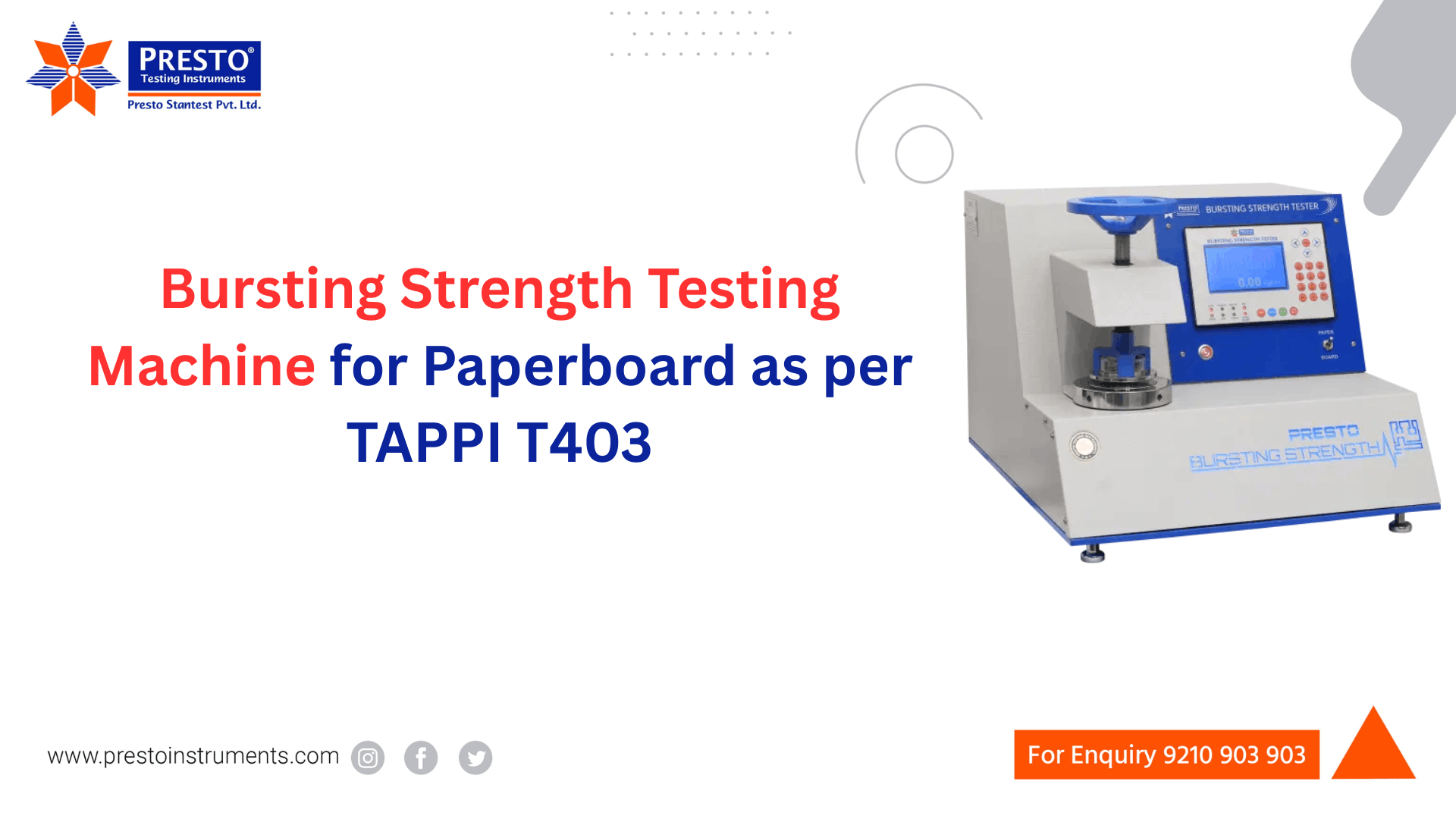
The globally accepted method for burst evaluation is defined by TAPPI T403. This standard specifies the determination of bursting strength using a diaphragm-type hydraulic instrument.
The test quantifies the maximum hydrostatic pressure required to rupture paper or paperboard when subjected to uniformly increasing pressure through a flexible diaphragm.
Complementary standards include:
Adherence guarantees favor in the domestic and export markets.
Bursting strength reflects resistance to multidirectional tensile stresses. Unlike compression tests (which measure stacking load), burst testing simulates internal rupture forces caused by:
A calibrated burst tester or burst testing machine allows manufacturers to establish process control limits, correlate GSM to burst index, and maintain consistent board performance.
For procurement and plant owners, this directly translates to reduced rejection rates and predictable packaging performance.
A burst strength tester operates on controlled hydraulic pressure transmission.
HAZ (heavy applied hydraulic pressure) causes a biaxial tensile stress in the sheet structure. Failure is experienced when the bonding strength of fiber and inter-fiber cohesion is surpassed.
The outcome of the test is as follows:
Strength of Bursting = Maximum Pressure/Area
For comparative evaluation across GSM variations, the Burst Index is calculated:
Burst Index = Bursting Strength/Grammage
Modern bursting strength tester digital systems incorporate:
This reduces operator-induced variability common in legacy analog bursting tester systems.
From an industrial diagnostics perspective, burst failure patterns reveal process deficiencies:
Indicates uniform sheet weakness—often due to low fiber bonding or insufficient refining.
Common in multilayer boards with poor interply adhesion.
Suggests improper clamping pressure or moisture imbalance.
Possible causes:
By correlating burst test data from the BS testing machine with production parameters, process engineers can identify root causes and implement corrective actions.
A robust burst test machine typically includes:
Presto’s systems are engineered to minimize diaphragm fatigue and maintain pressure rate stability—critical for standard compliance.
A precision BS tester is essential for:
In the case of manufacturers of high-temperature exported goods, the burst resistance is more of a problem because of moisture loss and fiber brittleness in the transportation process.
Irregular clamping force, fluctuating pressure rate, or substandard quality of the diaphragm may bend the results far out of proportion. The bursting strength machine might be inaccurately calibrated, and this can cause failure in the field.
This is the reason why serious QA laboratories are required to have calibration traceable to national standards and periodic validation.
As an established bursting strength tester manufacturer and global bursting strength tester supplier, Presto Instruments focuses on engineering reliability rather than generic features.
What differentiates Presto Instruments:
We are among the leading manufacturers of bursting strength testers, serving the Middle East (UAE, Saudi Arabia, Oman, Qatar), African countries (South Africa, Nigeria, Zambia, Ghana, Tanzania, Morocco, Kenya & Uganda), and international markets with durable, compliance-driven material testing instruments.
A high-precision bursting strength testing machine enables manufacturers to:
When your process requires specific testing of hydrostatic pressures, and this must be in line with TAPPI T403, ASTM D774, and ISO 2759, then Presto Instruments should be consulted to undertake a technical analysis or live demonstration.
It is used to measure the highest level of hydrostatic pressure that can be used to tear the paper or paperboard under controlled conditions.
Burst strength determines the multidirectional resistance to rupture, and compression strength determines the load capacity of vertical stacking.
Fiber bonding, GSM consistency, moisture content, refining process, ply adhesion, and consistency in manufacture.
Related Blogs for Bursting Strength Tester:
Elevate your quality assurance process to new heights
At Presto, we take pride in being Global manufacturers of Laboratory Testing Instruments for different industries.