
10-Mar-2026
Presto Instruments
Paper and corrugated cartons in the Kenyan packaging and manufacturing industries are the first line of defense for the products in terms of storage, shipping, and distribution. Poorly tested paperboard may cause spontaneous rupture, delamination, and fiber tear, particularly when subjected to high humidity, long haulage, or when stacked in large quantities.
Failure of cartons in transit can result in:
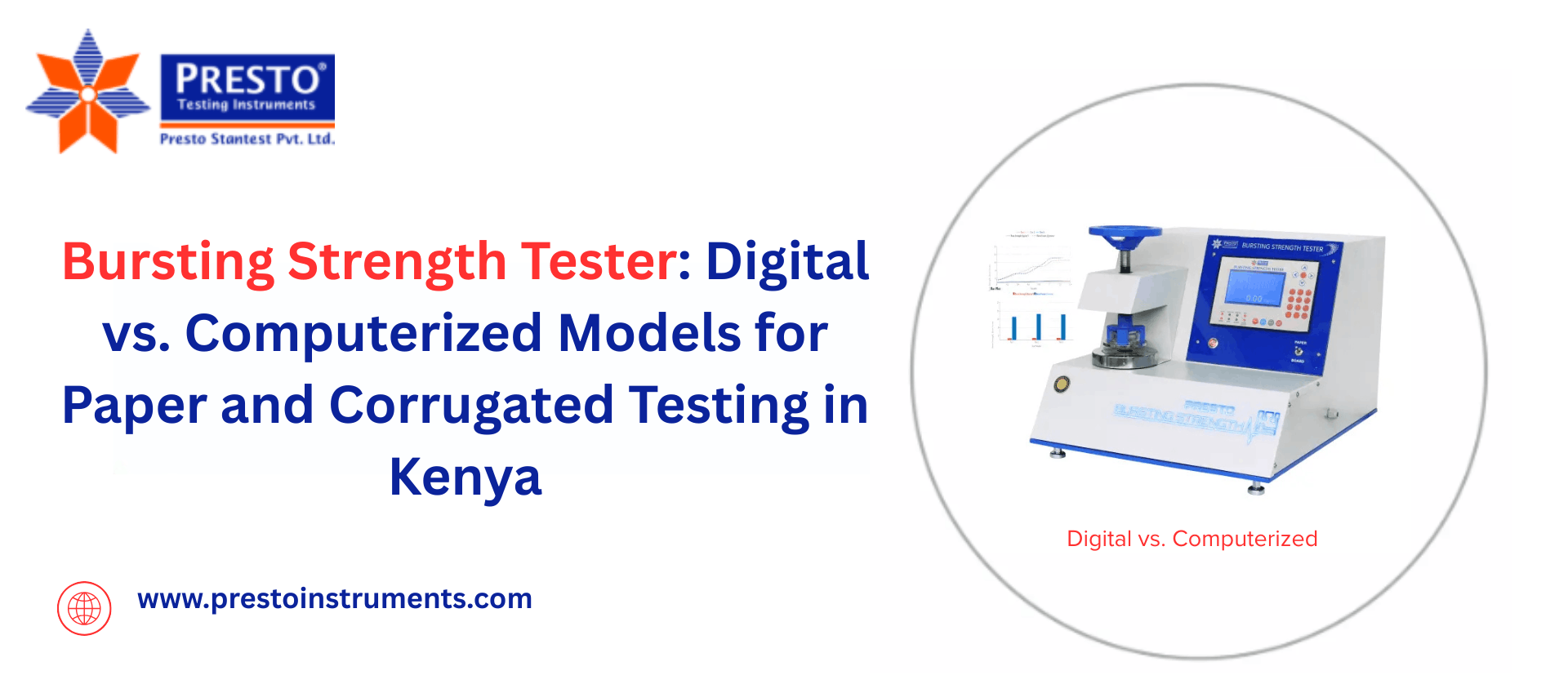
A burst test machine is a machine that identifies the highest pressure that a paper or corrugated sample could hold before breaking. The decision on whether to use a digital and computerized model should be based on the needs of the laboratory to automate, have an analytical control, and demonstrate traceability.
Both models measure the bursting strength, but computerized testers provide improved analysis, and a computerized tester allows an engineer to comprehend how failure progresses and how a material responds to pressure.
The bursting strength testing is used to calculate the ability of paper and corrugated board to withstand hydraulic or pneumatic pressure. This is essential since failure usually begins internally in the material structure, even before there are other signs of it.
Key benefits include:
Bursting tests in real-life applications can offer insight into the stress distribution and can be used by packaging engineers to optimize the carton construction and fiberboard choice.
A bursting strength machine puts a continuous hydraulic or pneumatic pressure on a paper or corrugated sample until it bursts.
Step-by-step operation:
This process enables the engineer to associate burst pressure and the material structure, including the orientation of the fibers, the layering of the ply, and the content of moisture in the material.
Understanding how and where a sample fails is just as important as measuring maximum pressure. Common failure modes include:
1. Localized Fiber Tear—Fibers in the sheet tear apart before the complete sheet tears up and is usually as a result of uneven bonding.
2. Delamination—Layers in multi-ply paperboard separate under pressure, reducing overall burst resistance.
3. Edge or Corner Rupture—Stress concentrates near edges or corners, especially in cut sheets or irregular samples.
4. Progressive Rupture—Micro-cracks accumulating gradually to attain a catastrophic failure, which is sudden.
The study of these failure modes enables engineers to design better paperboard, use more fiber, and choose corrugated construction of better strength.
The current BS testing machines are made accurate, consistent, and repeatable:
They enable labs to identify the slightest defects, streamline the quality of materials, and have controlled batches.
Applications Across Industries
Bursting strength testing is critical wherever paper or corrugated packaging is used:
Its versatility makes the burst tester a core component of modern industrial testing equipment in kenya packaging QA labs.
Adherence to International Standards
Dependable bursting strength tests are conducted according to internationally accepted standards, which are consistent and accepted worldwide:
Compliance ensures manufacturers in Kenya can meet export and regulatory requirements confidently.
Presto Instruments is a manufacturer of testers of bursting strength that are precision engineered and are capable of being used in laboratories over long periods.
Advantages include:
With Presto Instruments, laboratories are able to record consistent results of burst tests, establish a weakness in their materials, and enhance the quality of packaging.
The correct bursting strength test is important to avoid failure of the packaging during transportation and storage. Digital models are ideal for routine QA, offering quick, reliable burst measurements. Laboratories with research or export emphasis are provided with computerized systems that provide sophisticated data logging capabilities, real-time analysis, and reportability.
To achieve quality, reliability, and regulatory compliance, Kenyan manufacturers and labs need to invest in a Bursting Strength Tester Digital or a computerized one.
Contact Presto Instruments today for a demo, pricing details, or customized bursting strength testing solutions.
FAQs
1. What is the difference between digital and computerized bursting strength testers?
Digital models provide a direct display of the burst pressure, whereas computerized testers simplify the process of data collection affecting stress curves and create detailed reports.
2. What is the average price of the bursting strength tester?
Prices are dependent on automation, sample size, and features. Digital testers are cheaper compared to computerized testers that are more costly because analysis and reporting are advanced.
3. How do bursting strength testers find application?
Paper and board manufacturing, FMCG, pharmaceuticals, e-commerce, and logistics enterprises use the BS testing machines to guarantee quality.
4. What are the standards used in the bursting strength test?
The internationally recognized results are through the common standards TAPPI T403, ISO 2758, and ASTM D774.
Elevate your quality assurance process to new heights
At Presto, we take pride in being Global manufacturers of Laboratory Testing Instruments for different industries.