
10-Aug-2026
Presto Instruments
Packaging must protect products throughout handling, storage, and transportation. A drop impact tester helps manufacturers evaluate this protection by simulating controlled free-fall impacts and identifying weaknesses before products are shipped. In Kenya, this type of testing can help packaging manufacturers and exporters improve product durability and reduce damage during transportation.
Karibu! If your business packs, exports, or transports goods across Kenya—from Mombasa Port to Nairobi, Kisumu, or Eldoret, or across the border into Uganda, Tanzania, Rwanda, and beyond—the question isn't whether your cargo will be dropped, bumped, or stacked roughly during handling. It's whether your packaging can take it. Bidhaa nzuri huanza na kifungashio kizuri — a good product starts with good packaging, and good packaging starts with testing.
This guide is about the drop impact tester. It tells you what a drop impact tester is. The guide also talks about how a drop impact tester works. You will learn about the standards that apply to a drop impact tester. If you have a manufacturing operation in Kenya, or you are in logistics, or you export things, this guide will help you choose the right drop testing machine for your operation.
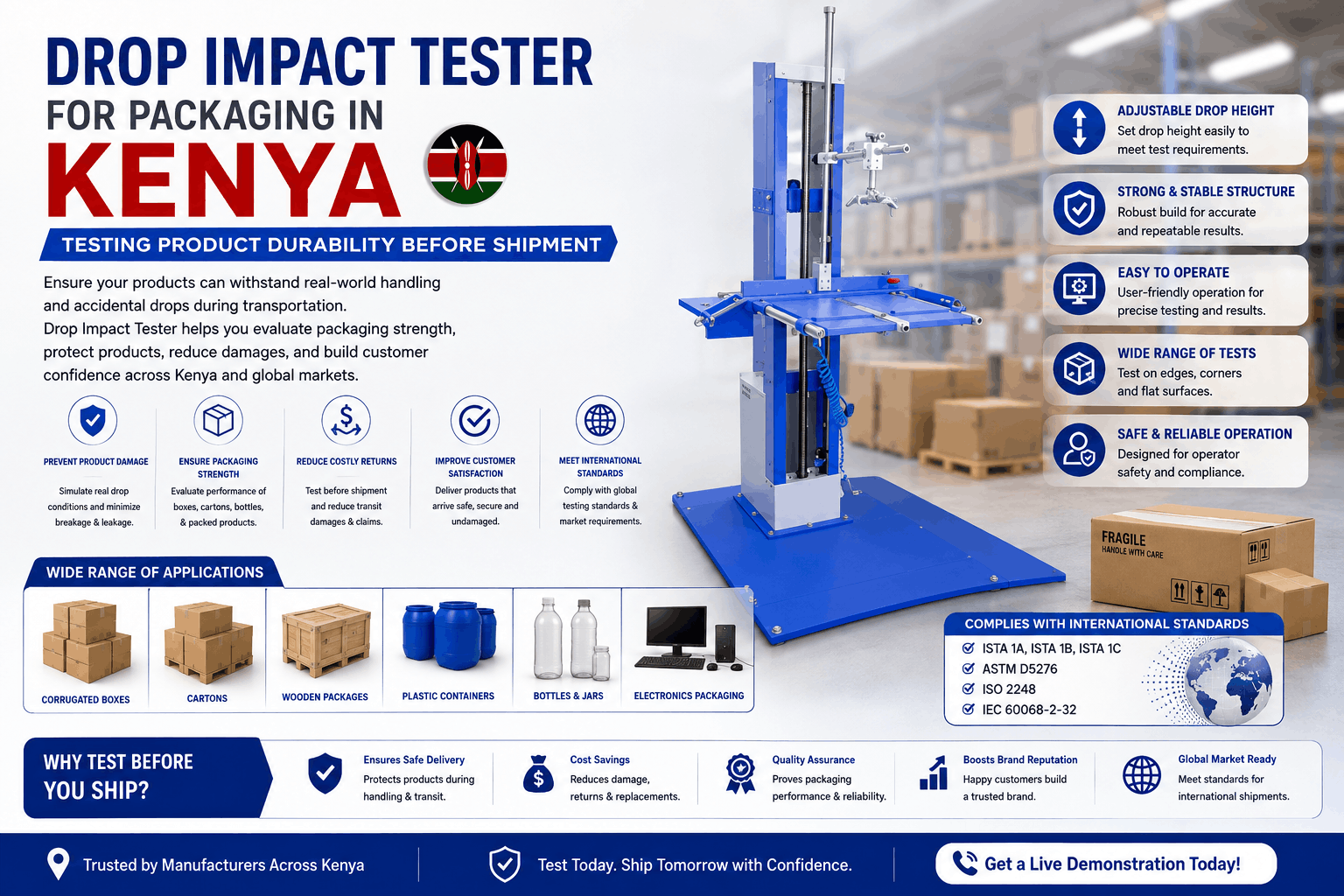
Kenya is a place for getting things from one place to another in East Africa. This means that things are moved to a storage room, from a truck to a big container at Mombasa or Namanga, from a ship to a special place by the water, and finally to a store shelf or the customer's house. Every time something is moved from one place to another, there is a chance that it will get dropped or knocked around or stacked up in a way that is not careful. Kenya’s role in getting things from one place to another is very important. Things are always being moved around in Kenya.
Usisubiri bidhaa zifike zikiwa zimeharibika — jaribu kabla ya kusafirisha. ("Don't wait for your goods to arrive damaged — test before you ship.") That's the entire logic behind drop impact testing: catch a packaging weakness in the lab, at almost no cost, instead of discovering it as a damage claim, a returned shipment, or a lost customer.
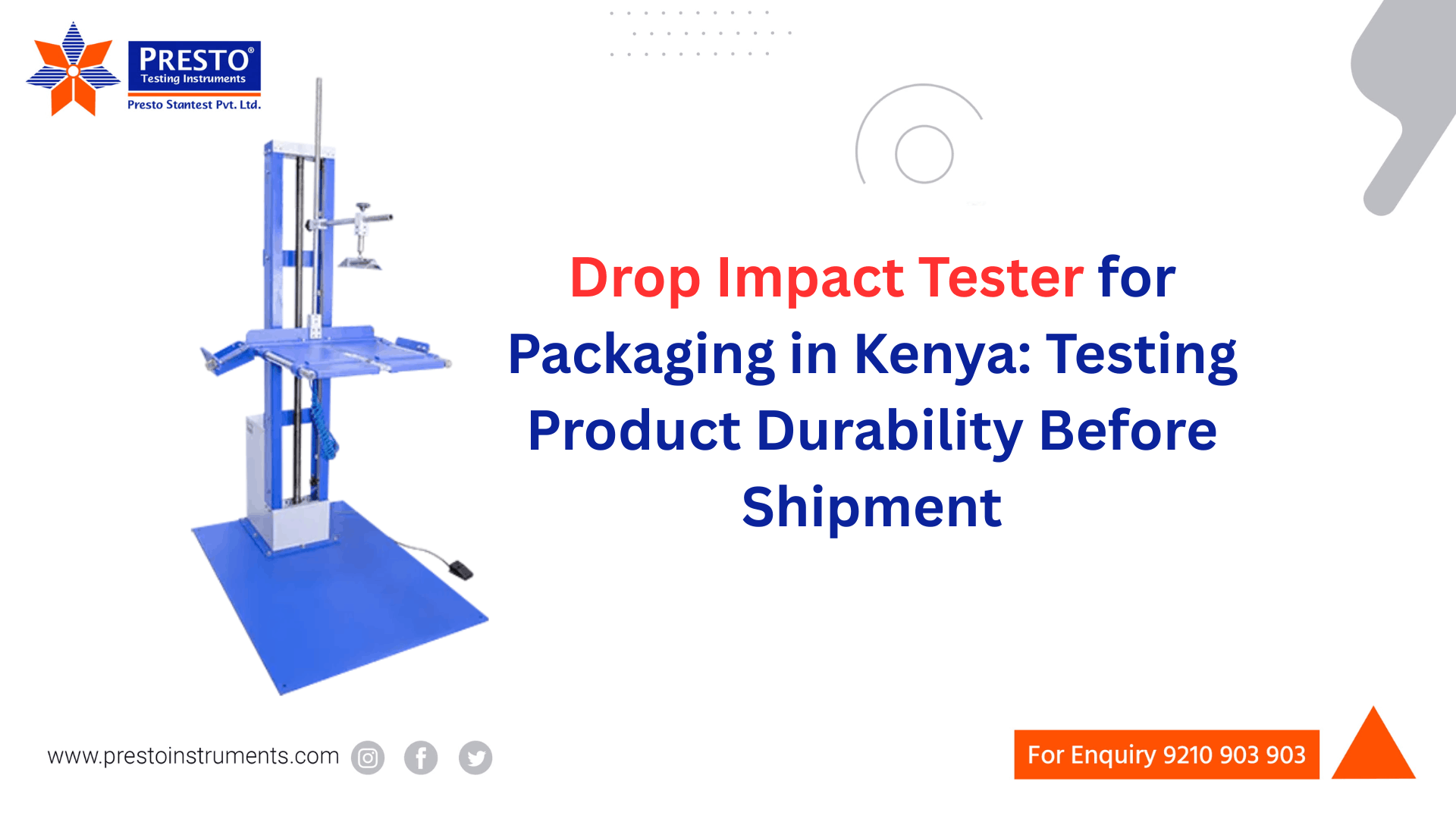
A drop impact tester, which people also call a drop tester or a packaging drop tester, is a machine that we use in a laboratory to see how a product that's packaged reacts when it is dropped. We lift up the box that has the product in it to a height and then let it fall so it hits a hard, flat surface. It can land on its face or on one of its edges or even on one of its corners. This is similar to what happens to a shipment when people are handling it or loading it or moving it from one place to another.
After each drop, the tester (or QC technician) inspects the product and packaging for:
The results tell manufacturers exactly where a packaging design is weak — before that weakness becomes a customer complaint, an insurance claim, or a rejected export shipment.
Two standards govern most drop testing for shipping containers and cartons worldwide:
For a Kenyan exporter, working with a machine and a lab process that align with these standards means your test data will be understood and accepted by overseas buyers, auditors, and freight partners — without needing to re-test at the destination.
The operating principle is straightforward, but the engineering behind it determines how accurate and repeatable your results are:
Presto Instruments is a manufacturer and supplier of drop impact testers and broader packaging testing equipment, serving customers across Kenya and the wider East African region alongside its global client base. As a company that sells drop testing machines in Kenya, Presto Instruments sends machines that are ready to use, along with instructions that follow international rules for drop testing. They also help laboratories and quality control teams set up the testing procedures.
If you are a manufacturer, exporter, or laboratory in Kenya looking for a company that sells drop impact testers, it is usually better to buy from the company that makes the machines. This way, you can see how much the machines cost, you can get replacement parts easily, and you can get help with setting up the machines and making sure they meet the necessary standards. Working with Presto Instruments, the manufacturer of drop impact testers, means you get all these benefits. Presto Instruments is a manufacturer and supplier that can provide you with the drop impact testers you need.
Presto has two models of drop testers that work well for different laboratories. These laboratories have different needs when it comes to how much work they can do and how much they want to automate things. Both models of the Presto drop testers can drop things from the same height and can hold the same amount of weight. The main difference between the two Presto drop tester models is how you actually use the platform.
|
Specification |
PDT-0135 (Motorised Pneumatic) |
PDT-0134 (Standard Drop Tester) |
|
Operation |
Motorised lift with pneumatic clamping and wired remote control |
Pneumatic-actuated platform with guided manual uplift mechanism |
|
Drop height range |
380 mm – 1800 mm |
380 mm – 1800 mm |
|
Drop orientations |
Flat, edge-wise, corner-wise (3-way wing structure) |
Straight and angular drop, single-instrument versatility |
|
Max. test box dimensions |
L 500 × W 500 mm platform |
L 500 × W 500 × H 500 mm |
|
Human-error control |
Remote-operated release minimises operator interference |
Drop-height adjustable clamp for consistent, repeatable drops |
|
Best suited for |
High-throughput labs wanting hands-off, repeatable automated drops |
QC labs wanting flexible straight and angular drop testing in one unit |
|
Power supply |
220V AC, 5 Amp, single phase, 50 Hz |
220V AC, 5 Amp, single phase, 50 Hz |
|
Product page |
Both models are built on a rugged base plate for stability under repeated impact testing and support the flat, edge, and corner drop orientations referenced in ASTM D5276 and ISO 2248 testing procedures. Buy a drop impact tester in Kenya today!
Phone: +91 9210903903; Email: response@prestogroup.com
Chagua vizuri — choose wisely. The right model depends less on price alone and more on how your lab actually operates:
The price of a drop impact tester depends on what model you get, how much automation it has, how high it can drop something, and what kind of help you get after you buy it. This help can include things like someone showing you how to set it up, papers that tell you how to make sure it is working right, and getting parts when you need them.
Generally, a standard drop tester that can handle an amount of weight will cost a pretty average amount of money for a big piece of equipment. The drop impact testers that have motors and can be controlled from afar, like the PDT-0135, cost more than the ones that you have to lift by hand, like the PDT-0134. This is because the ones with motors have automation, which makes them more expensive.
For an accurate, current drop tester price in Kenya, including freight and installation support, it's best to request a direct quote from a drop tester supplier in Kenya—costs can shift with currency exchange, shipping method, and any customization to the test platform.
Wasiliana nasi leo kwa bei sahihi na maelezo zaidi—Contact us today for accurate pricing and further details.
Usiache ubora wa bidhaa yako kwa bahati — don't leave your product quality to chance. Whether you're a manufacturer preparing for export, a packaging converter validating carton designs, or a QC lab building out testing capability, a properly specified drop impact tester pays for itself the first time it catches a packaging flaw before a customer does.
You should talk to Presto Instruments about the drop height and load you need for your tests. They can also help you with following the standards. If you want to buy the PDT-0135 or PDT-0134 drop tester for your place, get a quote for a drop impact tester in Kenya.
Q. What is a drop impact tester used for?
Ans: A drop impact tester is used to see how well a product and its packaging can withstand being dropped. The drop impact tester checks this by testing the product and its packaging. This is important when the product is being handled, moved around, or stored.
Q. Is a compressor required to operate a Presto drop tester?
Ans: Yes, both of these machines need a kind of air supply. This air has to be cleaned and controlled, and it has to be strong. We are talking about five bars of pressure and five cubic feet of air per minute. The machines use this air to clamp and release things. You will need to get an air compressor to make this work. The air compressor does not come with the machine when you buy it. You have to get that.
Q. What is the difference between a drop tester and a vibration table?
Ans: A drop tester is used to see how something holds up when it is dropped or handled roughly. This tester helps to find out what happens when something falls. On the other hand, a vibration table is used to see how something does when it is moved around a lot, like when it is being shipped on a road or by train or plane. Many labs that do tests for things that will be sent to countries use both of these testers to make sure that the packaging is good enough.
1. Choose the Best Drop Impact Tester Machine Supplier in the UAE for Accurate Impact Testing
2. Drop Test Machine Supplier in Nigeria: Safe Packaging for Industrial and Export Applications
Elevate your quality assurance process to new heights
At Presto, we take pride in being Global manufacturers of Laboratory Testing Instruments for different industries.