
23-Mar-2026
Presto Instruments
Due to the high temperature and humidity conditions in Oman, any small shortcomings in the heat sealing may lead to disastrous packaging breakdowns. By using an accurate plastic heat sealer, we can identify weak or inconsistent seals that lead to the following:
Those failures often do not happen due to the materials but rather to the inconsistent set of heat sealing parameters, such as temperature, pressure, and dwell time, which are not observed with regard to the fast and busy production settings.
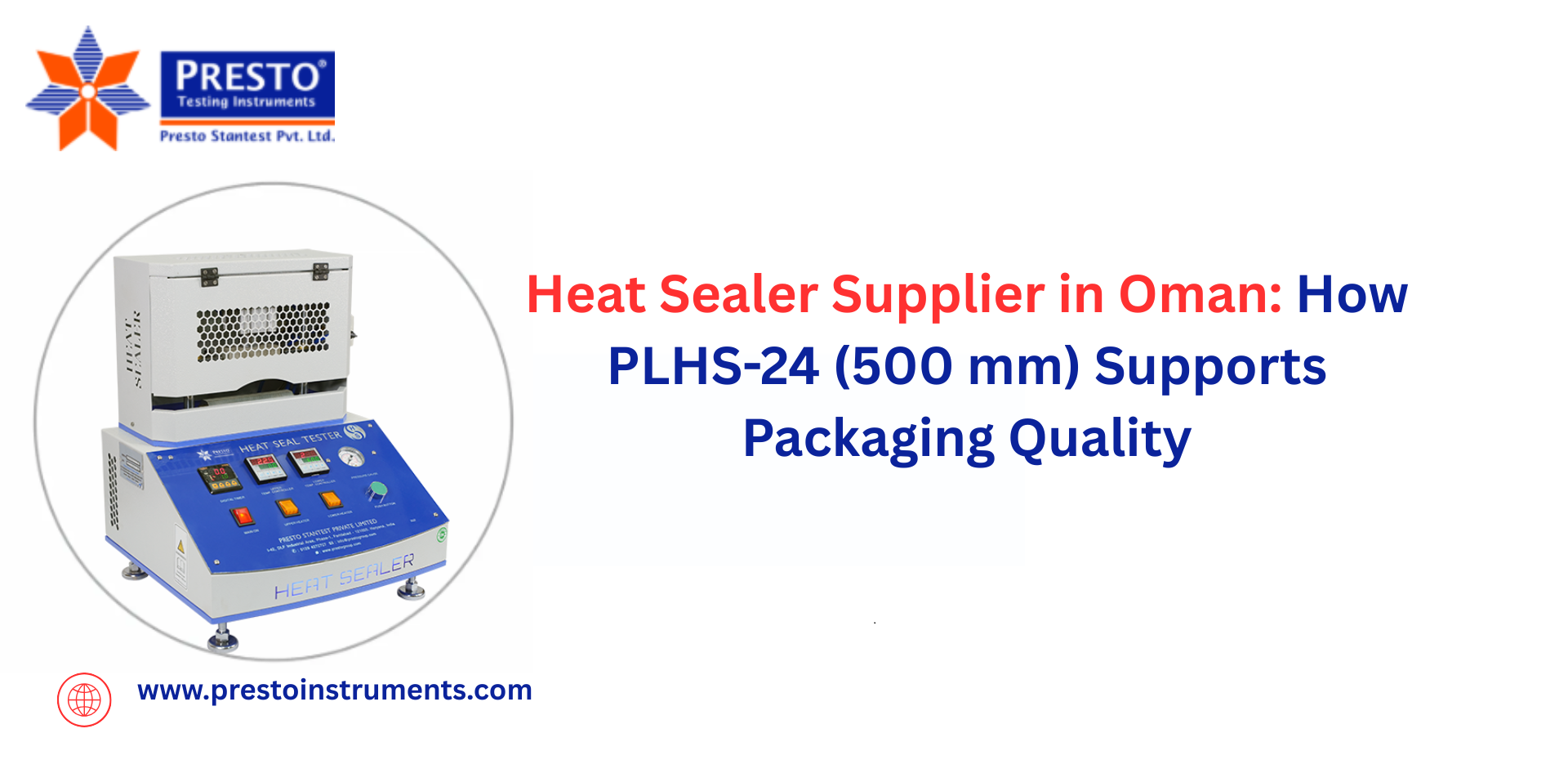
The QA managers, packaging engineers, and production heads need accurate, repeatable tests that will identify weak seals before their products are introduced to the market for which they use heat sealing machines in Oman. The heat sealing machine set by PLHS (24) 500 mm is meant to ensure this important quality assurance.
Omani packaging regulations and industry standards emphasize seal integrity. Key references include:
The PLHS-24 heat sealer machine replicates industrial heat sealing conditions in a controlled lab environment, enabling manufacturers to validate seal performance across films, laminates, and pouches in accordance with these standards.
Seal integrity is the first line of defense against product failure. Insufficient testing can result in:
By employing a laboratory heat sealing machine, manufacturers can:
This proactive strategy is directly associated with product loss minimization and better regulatory compliance in the Oman-based, export-oriented industries.
The PLHS-24 operates on a controlled temperature-pressure-time principle:
Stress Mechanics
In sealing, the layers of polymer are softened by heat, and the interlayers are bonded by pressure. Failure occurs when:
Modern digital laboratory heat sealers capture these parameters with high accuracy, allowing precise reproducibility of industrial sealing conditions.
A deeper understanding of seal failure helps in process optimization:
| Failure Mode | Likely Cause | Observed Effect | Corrective Action |
| Cold Seal | Low temperature or short dwell | Seal splits under stress | Adjust temperature/dwell time |
| Delamination | Laminate incompatibility | Layer separation | Review material selection |
| Edge Fracture | Uneven pressure | Seal fails at corners | Uniform clamping/pressure calibration |
| Overheating | Excess temperature | Film degradation | Optimize heating profile |
| Inconsistent Seal Strength | Operator variability | Variable peel strength | Digital control & automation |
Through test data and material property correlation, engineers are able to streamline the process parameters in order to achieve a consistent quality of seals.
Benefits:
Technical Specifications
| Parameter | PLHS-24 Standard Configuration |
| Sealing Bar Length | 500 mm |
| Temperature Range | 50°C – 300°C (digital control) |
| Pressure Range | 0 – 10 kg/cm² |
| Seal Time | 0–60 sec |
| Operation | Manual/Pneumatic |
| Power Supply | 220V AC, 50 Hz |
| Testing Capabilities | Peel, burst, visual inspection |
Custom configurations are available for thicker laminates or specialized high-barrier films.
The PLHS-24 supports multiple sectors:
Its versatility allows lab technicians and QA managers to evaluate seal integrity across diverse materials and use cases.
Presto Instruments is a universal heat-sealing machine manufacturer and supplier of instruments in Oman. Advantages include:
We specialize in providing repeatable and precise data to QA laboratories, manufacturing plants, and packaging-based, export-oriented firms.
The integrity of seals is a highly important concern when it comes to product safety, compliance with regulations, and the brand image. The PLHS-24 lab heat sealing machine provides controlled, repeated, and standardized testing to test heat seals in food, pharmaceutical, and industrial packaging. Make sure your packaging is heat-sealed to the standard in Oman.
Call Presto Instruments for a real-time demo, a technical consultation, or a customized quote for the heat sealer machine price in Oman.
FAQs
Q.What are the applicable standards for sealing heat in Oman?
Ans It measures the integrity of seals in movies, envelopes, and strata packaging.
Q.Can PLHS-24 handle wide-format pouches?
Ans Yes, its 500 mm sealing bar accommodates large formats and multi-layer laminates.
Q. What are the industries in which a laboratory heat sealer can be helpful?
Ans Food, pharmaceuticals, industrial chemicals, consumer products, and packaging of exports.
Elevate your quality assurance process to new heights
At Presto, we take pride in being Global manufacturers of Laboratory Testing Instruments for different industries.