
12-Mar-2026
Presto Instruments
In Egypt’s beverage and edible oil sector, PET bottle failures are rarely random events. They are normally associated either with uneven distribution of the material, imprecise stretch ratios, or unnoticed micro-deformities on molding. When bottles collapse under top-load in warehouses, crack at the base during carbonation pressure testing, or fail drop tests during export transit, the root cause often lies in poor sectional analysis.
Wall thickness measures cannot be accurate without a proper cross-sectional slice cut. In case the sample itself is skewed by means of preparation, all subsequent measurements, such as mapping of the thickness, study of crystallinity, or stress analysis, are doubted.
This is why precision sample preparation is fundamental to PET bottle testing and why a technically robust hot wire bottle cutter is not a peripheral tool but a critical laboratory instrument.
Injection Stretch Blow Molding (ISBM) introduces biaxial orientation in PET. The mechanical strength of the bottle depends on:
If wall thickness varies excessively between shoulder, body, and base regions, failure modes shift unpredictably.
To diagnose these issues accurately, the bottle must be sectioned without introducing mechanical stresses that mask real production defects.
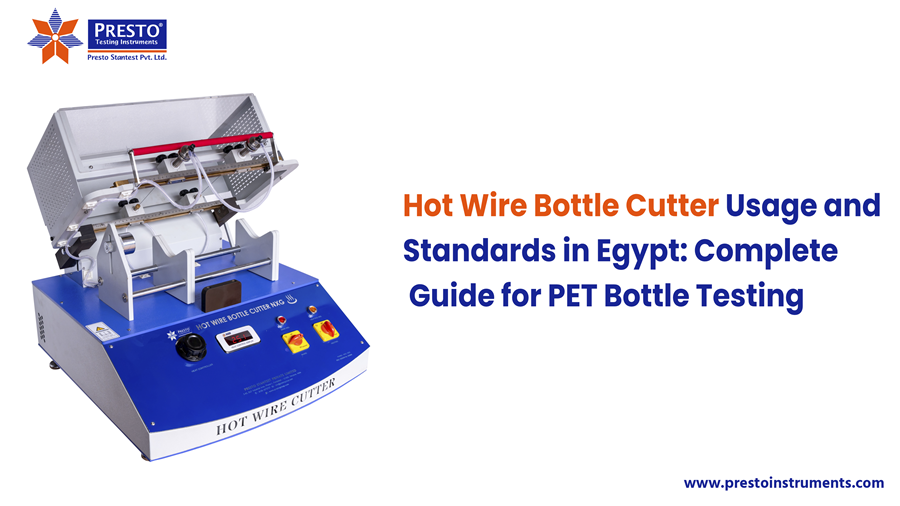
A hot wire bottle cutter machine uses a resistance-heated wire—typically nichrome—to thermally melt through PET with controlled energy input.
Core Components
Technical Operation
The key engineering variable is thermal control stability. Excess heat can cause:
Insufficient heat leads to drag marks and partial tearing.
A high-quality hot wire PET bottle cutter ensures consistent heat distribution along the wire length, preventing uneven cutting.
Sample preparation can create artifacts that resemble manufacturing faults due to the improper sample preparation.
1. Stress-Induced Whitening
Mechanical blade cutting compresses PET walls, causing micro-yielding. This produces whitening at cut edges, often misinterpreted as material stress from molding.
2. Wall Compression Error
Thin regions may compress under blade pressure, giving false lower thickness readings. For bottles operating near minimum design thickness, this leads to incorrect rejection.
3. Microcrack Initiation
Cold cutting tools can initiate cracks that propagate during burst testing, falsely indicating material weakness.
4. Thermal Degradation Risk
If the wire temperature is uncontrolled, PET may overheat, altering local crystallinity and skewing interpretation of orientation studies.
A precision hot wire bottle cutter manufacturer mitigates these risks through controlled power regulation and stable mechanical alignment.
Sectional samples prepared using a hot wire bottle cutter machine are typically analyzed for:
Standards from:
Define mechanical and transit testing methods where accurate sample preparation directly influences data reliability.
Although the cutter may not have an individual ASTM number, it facilitates the ability of tensile, compression, and structural evaluation criteria.
When selecting a Hot Wire Bottle Cutter Supplier in Egypt, industrial buyers should assess:
Repeatability is often overlooked. Inconsistent cut positioning makes comparative thickness mapping unreliable across batches.
Accurate PET bottle testing supports:
Beverage Manufacturing
Edible Oil Packaging
Pharmaceutical Packaging
Export-Oriented Packaging
In each case, sectional analysis forms the foundation for structural validation.
Presto Instruments designs precision-engineered material testing instruments tailored for packaging laboratories.
Engineering Focus
Laboratory Integration
Presto Instruments’s Hot Wire Bottle Cutter machine integrates seamlessly with other industrial testing machines used in PET bottle testing workflows, including top-load testers and burst testers.
Lifecycle Support
To the QA managers and heads of production, the long-term reliability and consistency of measurements are of greater importance than the short-term procurement cost.
Accurate Testing: Cuts the Key to Consistent PET Bottle Testing
In PET packaging quality control, inaccurate sample preparation leads to incorrect conclusions. When cross-sectional samples are distorted, thickness mapping and structural evaluation lose credibility.
A precision hot wire bottle cutter ensures:
Good PET bottle testing in Egypt entails the right equipment for the manufacturers supplying both local and foreign markets.
Call Presto Instruments today and get a technical consultation on their products, product specifications, and even live demonstrations, depending on your laboratory demands.
FAQs
Ans. It prevents mechanical stress and deformation that can distort thickness measurements.
Ans. Yes, excessive heat may alter local crystallinity, affecting analysis accuracy.
Ans. Yes, adjustable fixtures accommodate varying diameters and heights.
Elevate your quality assurance process to new heights
At Presto, we take pride in being Global manufacturers of Laboratory Testing Instruments for different industries.