
02-May-2026
Presto Instruments
Why do coated parts begin to corrode earlier than expected in Oman? The query has appeared frequently in the metal industry, including metals coated with a metal-polymer type of coating. There is a possibility of passing at the first stage of inspection but failing when subjected to the actual conditions of work. High humidity and coastal air differences in temperature provide a hostile environment that enhances corrosion. These aspects gradually deteriorate surfaces and increase the duration of products without any apparent notice in the initial phases.
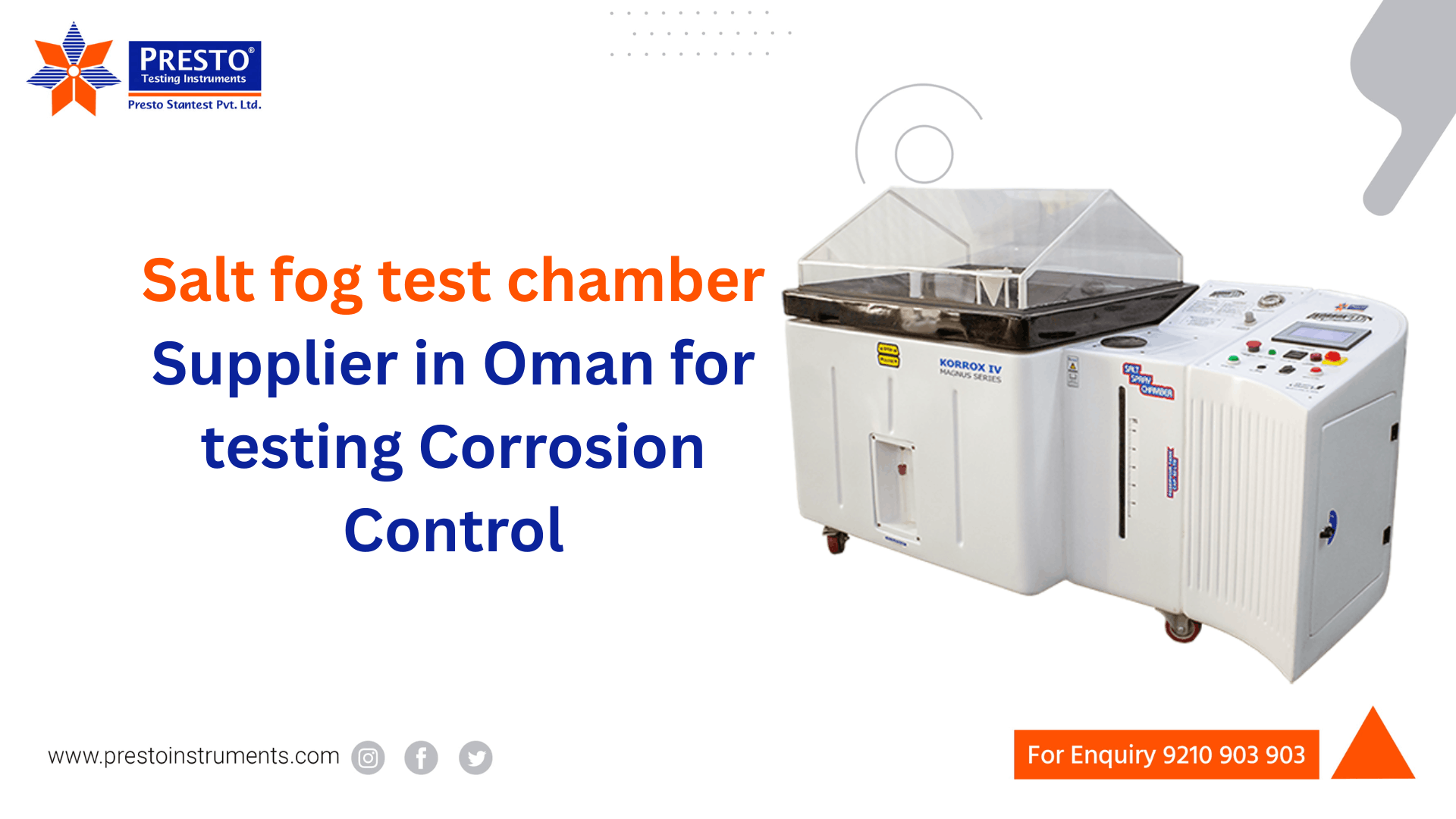
A salt fog chamber helps study this behavior in a controlled environment. It recreates salt-rich conditions and exposes samples to continuous mist. This allows industries to observe how coatings and materials react over time. Weak coatings, surface defects, and poor material choices become visible during testing.
Using the right system and testing method helps industries make better quality decisions. It reduces the risk of failure in the field and supports the long-term performance of products used in demanding environments.
Industries in Oman operate under conditions where corrosion risk is always present. Coastal regions increase exposure to salt-laden air. Other stressful factors are added by industrial surroundings that are stressed with chemicals and moisture. Metals, coatings, and assemblies are impacted in a variety of ways by these conditions.
Corrosion testing allows industries to identify these weaknesses before products are deployed. It eliminates possibilities of unforeseen breakdown when the machine starts to operate. It is particularly crucial in industries like oil and gas, marine, construction, and infrastructure. Any minor fault can result in huge economic loss and danger to health.
A salt fog chamber in Oman provides a controlled way to simulate these harsh conditions. It allows quality teams to compare different materials and coatings under the same environment. This makes evaluation more accurate and practical.
For export-driven industries, corrosion resistance is often a requirement. Buyers expect proof of durability through proper testing.
Testing without standards creates confusion. Unless methods are controlled, results may vary between commercially prepared test kits and individually prepared tests (also known as in-house tests). This complicates the ability to compare against materials or validate performance.
Standards promote the way to perform the test. They lead in developing the salt solution, chamber temperature, exposure time, and the evaluation criteria. This generates a universal approach that can be tracked across fields.
The common standards in salt mud testing are ASTM B117, ISO 9227, and DIN 50021. These standards are commonly used in international industries. They assist in ensuring that there are consistent testing procedures and an increase in confidence in the outcomes.
In the case of Omani industries, these standards hold some significance not only in the local quality control but also in the export compliance. Buyers often require reports based on these methods.
A proper salt fog chamber should support these standards. It assists in maintaining consistency, accuracy, and acceptance of the test results in various markets.
Preparation of samples contributes significantly to the accuracy of tests. Even a high-quality chamber could not deliver the correct results in case the samples were not prepared correctly.
The surfaces should be clean and should not contain any oil or grease, dust, or any other type of contamination. Even minute residues have an impact on corrosion behavior. Because of uniformity, coated samples are to be examined before testing. Any difference in the thickness of the coating can give dissimilar outcomes.
There are also edges and corners to look into. These are more prone to corrosion and can have an overall effect on the overall results. The correct treatment during preparation is not to end up in conditions that may interfere with testing.
This is done by preparing the samples in a uniform way, which ensures uniformity. It enables comparing various materials and coatings under the same conditions.
Reliability is enhanced, and variation in the results is minimized through a disciplined approach to preparation. It can also assist quality teams to arrive at correct decisions, highly informed by test results.
Industries in Oman tend to compare local and international manufacturers before purchasing. Both alternatives have some benefits.
The local manufacturers normally offer a quicker response period. There is facilitated communication and improved service support. This will facilitate rapid repairs and the supply of spare parts. This may be an advantage in the case of industries that demand immediate support.
Global manufacturers bring advanced technology and wider experience. Their systems, in many cases, provide improved control, durability, and long-term performance. They also come with experience in and around the various industries and applications. This helps in handling complex testing requirements.
Selection of the last option is based on application, budget, and support expectations. In many industries, the trend is to select suppliers who have not only integrated state-of-the-art system design capabilities but also have a good local service support system.
Choosing the appropriate manufacturer can serve to ensure uniform performance and, over time, eliminate challenges in the field of operation.
Even with a good machine, errors during testing can affect results. Many issues come from improper testing practices.
One of the most typical errors is the improper sample placement. Uneven exposure to salt mist will be received in case samples are not correctly positioned.
An incorrect salt solution concentration also affects testing. The solution must match standard requirements. Any variation changes the corrosion rate and makes the results unreliable.
Ignoring cleaning and maintenance is another issue. Residue inside the chamber can affect spray distribution. This reduces the accuracy of testing conditions.
Omission of the calibration can also result in errors. The performance of the system might also differ over the course of time unless the performance is regularly checked.
The best way to prevent these errors is through correct procedures and upkeep of the chamber. It enhances the quality of findings and makes quality decisions.
A salt fog chamber like Presto Cass Cum Salt Spray Chamber (250 Litres) – Touch Screen is not just a testing device. It is one of the main aspects of quality control. Wrong testing may cause severe issues in the case of decisions based on incorrect testing.
Inadequate testing can lead to a failed coating, material rejection, or post-deployment damage of the product. This increases cost and affects brand reputation.
A quality chamber is helpful to prevent problems at their initial stage. It enables industries to test coatings and compare materials, and identify the appropriate combination to use under certain circumstances.
In these cases, it is even more significant when it comes to Omani industries operating in environments of a harsh nature. Products must perform under continuous exposure to corrosive elements.
Long-term risks can be mitigated through investing in the right system that has the right support. It enhances product durability and creates trust in quality. It is also assistive in ensuring that industries are able to live up to the local and international expectations.
1. What is the purpose of a salt fog chamber?
A salt fog chamber is an experimental approach to simulating corrosive conditions and testing how materials resist corrosion and wear over time.
2. What is the importance of corrosion testing in Oman?
Corrosion testing can assist industries with the harsh shore conditions, decreased product failure, and progress on durability in real-life operating conditions.
3. What are the standards applied in salt fog testing?
There are common standards such as ASTM B117, ISO 9227, and DIN 50021 in reference to uniform and worldwide accepted methods of corrosion tests.
4. How to choose a salt fog chamber manufacturer?
Select a manufacturer who has technical knowledge, good support services, and experience in the provision of accurate and stable corrosion testing systems.
5. What influences the outcomes of tests in salt muds?
Salt concentration, temperature, humidity, and exposure time are included in the list of factors that influence the accuracy of the corrosion test results.
Elevate your quality assurance process to new heights
At Presto, we take pride in being Global manufacturers of Laboratory Testing Instruments for different industries.