
25-Mar-2026
Presto Instruments
Threading cosmetic packaging systems to prevent the loss of liquid and semi-liquids (lotions, serums, shampoos, and creams), they utilize threaded closures. Although these closures seem to be straightforward, the amount of force used to perform capping determines the integrity of the package directly.
Torque testing is used to determine the rotational force necessary to either put on or take off a threaded closure on a container. In the quality control of cosmetic packaging, this test confirms that the closures are in the best range of torque to ensure a proper seal and usability by the consumer.
Using a torque testing machine, laboratories measure key parameters, including
Such measurements assist the engineers to identify a deviation in the performance of the packaging and impose corrective measures before the products pass through the distribution channels.
The aspect of torque control in Tanzania has a direct effect on the different packaging performances.
Maintaining Seal Integrity
There is the correct torque that compresses the closure liner to the container finish to create an efficient seal barrier. The lack of compression can permit the liquid movement, micro-leaks, or evaporation.
Preventing Thread Damage
This may cause overstressing of plastic threads, leading to thread stripping or permanent deformation, which impairs performance of reclosures.
Controlling Consumer Opening Force
Packaging must be easy to open without tools. Over-tightened caps increase removal torque and reduce user convenience.
Detecting Process Drift
Automated capping equipment may gradually deviate from target torque due to mechanical wear, lubrication changes, or speed variation. Routine torque testing provides early detection of these issues.
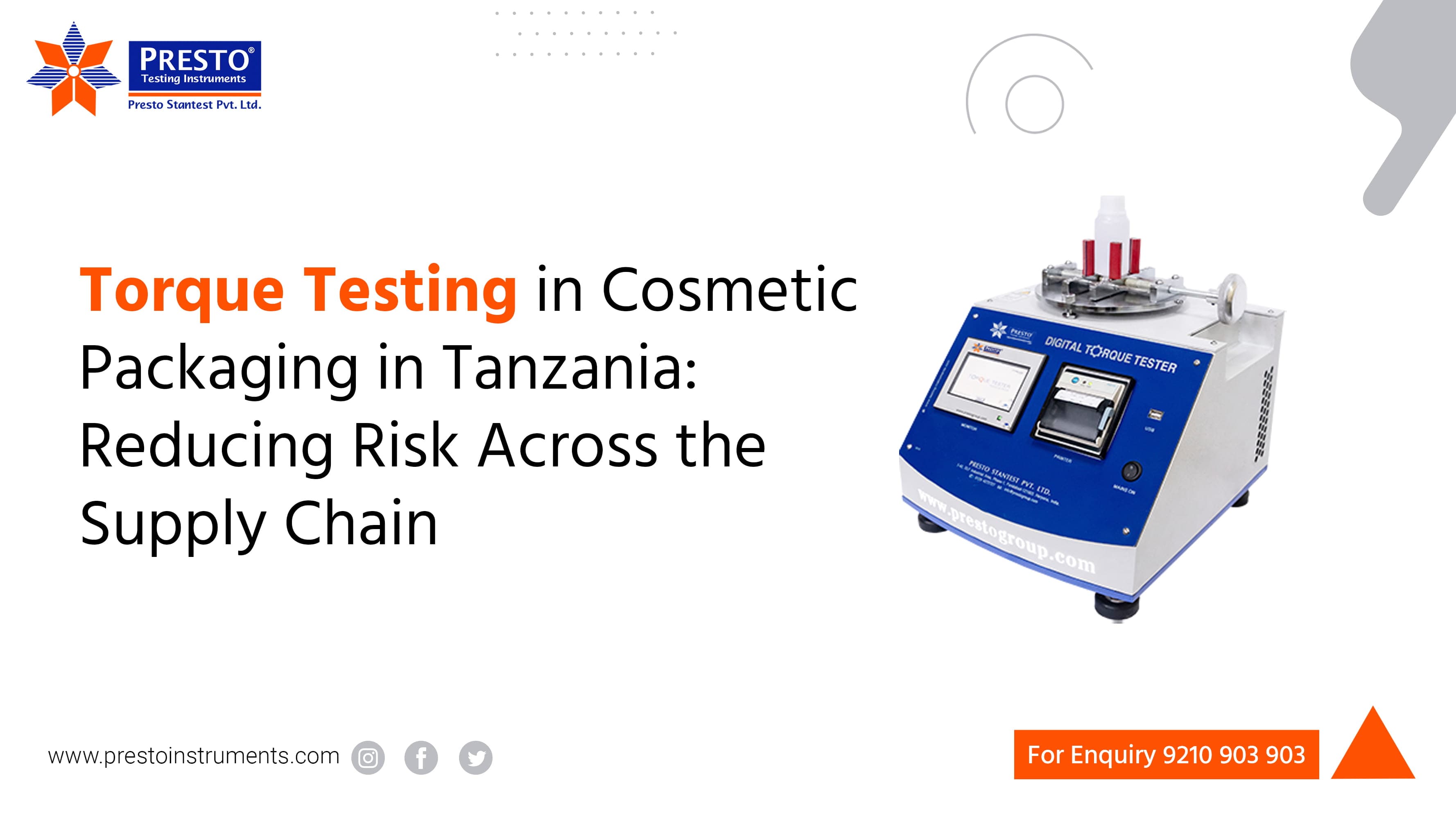
A torque testing machine in Tanzania measures rotational force using precision torque sensors integrated with a container holding fixture.
Test Method
1. The cosmetic container is positioned securely on the tester platform.
2. The closure is engaged with the torque sensor through a gripping mechanism.
3. The operator rotates the closure until the cap begins to loosen.
4. The system records the peak torque required to initiate closure movement.
5. The measured value is displayed digitally and stored for quality analysis.
The modern torque testers are equipped with high-resolution sensors that measure small torque changes, which can be effectively used to monitor the performance of closure in different production batches.
Torque testing provides valuable insight into closure performance issues.
Under-Torque Failure
Occurs when the cap is insufficiently tightened, often due to incorrect capping machine settings or liner compression variation. This leads to leakage during handling or transport.
Over-Torque Failure
Excessive torque may lead to distortion of the thread or damage to the liner, thus making opening the closure hard.
Thread Stripping
In case the applied torque is greater than the structural strength of the structure or thread on the bottle, the threads can shear or deform.
Torque Relaxation
Plastic closures may gradually lose applied torque over time due to material creep or thermal expansion, particularly in hot storage conditions.
Understanding these failure mechanisms helps packaging engineers refine both closure design and capping process parameters.
Modern torque testing equipment used in packaging laboratories includes the following:
These capabilities allow QA teams to perform reliable and repeatable torque testing during routine production monitoring.
While widely used in cosmetics, torque testing systems are also essential in other packaging sectors.
Cosmetics Industry
Shampoo, lotion, cream, and cosmetic serum bottle tops.
Pharmaceutical Packaging
Child-resistant closures and tamper-evident medicine bottles.
Beverage Industry
PET bottles and aluminum closures.
Chemical Packaging
Containers of detergents, lubricants, and industrial liquids.
Accurate torque testing methods follow internationally recognized testing practices, including:
Adherence to such standards makes the measurement of torque consistent, repeatable, and acceptable all over the globe.
In Tanzania Presto Instruments develops advanced torque testing Equipment solutions designed for packaging laboratories and manufacturing environments.
Presto torque testing equipment offers the following:
The capabilities enable manufacturers to achieve uniformity in packaging performance and minimize the failures that are associated with closures.
Closure torque is a factor of direct importance to product protection, stability in transport, and usability by the consumer in cosmetic packaging. Even minor variations in the amount of torque may cause leakage, thread damage, or a poor user experience. The adoption of torque testing in cosmetic packaging enables manufacturers to manage the closure performance and control the production quality, as well as minimize the packaging failures throughout the supply chain. By having state-of-the-art torque testing machines and torque testing equipment, the manufacturers are able to guarantee that all closures have the appropriate torque in accordance with the specifications of reliable packaging performance.
Presto Instruments of Tanzania offers high-quality torque testing systems that have proved to be dependable in terms of quality control when used in the manufacture of modern cosmetic packaging industry.
FAQs
1. How much is the price of the torque tester in Tanzania for the packaging laboratories?
The price of a torque tester in Tanzania will depend on the range of measurements, the precision of the sensor, the digital characteristics, and the ability to store it in the container.
2. Why is torque testing important in cosmetic packaging?
Torque testing is used to verify that the closures are firmly tightened to the proper range so as to avoid leakage and remain easy to open by a consumer.
3. What industries use torque testing equipment?
Torque testing equipment has an extensive application in cosmetics, pharmaceuticals, beverages, chemicals, and food packaging.
4. How do the manufacturers identify a competent supplier of torque testers?
The manufacturers ought to look at the accuracy of testing, even international standards, equipment durability, calibration service, and technical support.
5. What torque testing methods are used for packaging closures?
Common torque testing methods include application torque testing, removal torque testing, bridge break torque measurement, and strip torque evaluation.
Elevate your quality assurance process to new heights
At Presto, we take pride in being Global manufacturers of Laboratory Testing Instruments for different industries.