
25-May-2026
Presto Instruments
A collapsed pallet in a warehouse crushed cartons at the bottom layer of a container, and holes in boxes when transporting across countries; these failures are not occasional failures but mechanical failures of performance based on the wrong choice of material or lack of testing.
For QA managers and packaging engineers, the debate around bursting strength vs ECT is not theoretical. It directly affects:
The choice of the incorrect performance parameter may result in over-engineered (expensive) packaging or underperforming cartons that are likely to compress or rupture.
In order to make the correct choice, one needs to be capable of knowing what each of the tests actually measures on a structural level.
What Bursting Strength Actually Measures
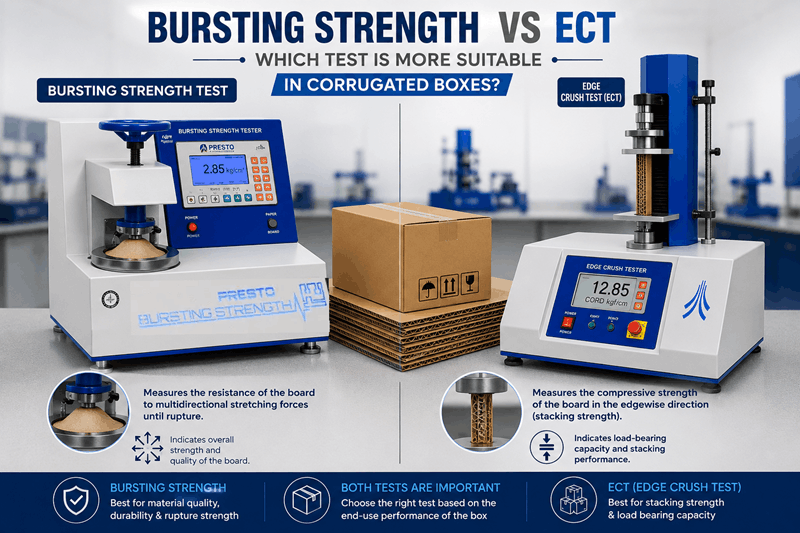
Bursting strength quantifies the board’s resistance to multi-directional hydraulic pressure until rupture. It is traditionally associated with the Mullen test and performed using a burst strength tester or burst testing machine.
Mechanical Behavior Evaluated
Failure typically occurs when the liner fibers rupture after exceeding tensile limits. If bonding between the flute and liner is weak, premature delamination may occur.
Bursting strength is particularly relevant where packaging faces:
ECT evaluates the edgewise compressive strength of corrugated board, directly related to stacking performance.
In ECT, load is applied parallel to the flute direction, simulating vertical stacking conditions. The measured value correlates strongly with Box Compression Test (BCT) performance using McKee’s formula.
Mechanical Behavior Evaluated
Common Failure Modes in ECT
ECT does not measure puncture resistance; it measures columnar load-bearing capacity.
|
Logistics Condition |
Dominant Failure Mode |
Recommended Focus |
|
High pallet stacking |
Column buckling |
ECT |
|
Rough transport |
Liner rupture |
Bursting strength |
|
Export via sea freight |
Humidity + stacking |
ECT + burst |
|
Manual loading/unloading |
Impact & puncture |
Bursting strength |
In modern supply chains, ECT-rated boards are increasingly adopted for cost-efficient stacking optimization. However, in certain export-heavy sectors, bursting strength remains critical.
A precision bursting strength tester digital system includes:
Test Process
Test accuracy depends on:
Even slight clamping misalignment can introduce result variation—hence instrument precision is critical.
ECT is conducted using a compression testing machine with parallel compression platens.
When the sample is not prepared correctly, there is the possibility of premature failure because of the uneven distribution of the stress.
Reliable test results must comply with internationally recognized standards such as
Compliance ensures acceptance in domestic and global markets.
Presto Instruments designs high-performance burst test machines engineered for industrial repeatability.
Being a well-known manufacturer of bursting strength testers, Presto pays attention to the repeatability, the diaphragm consistency, and the stability of the calibration over a long period of time.
It depends on the failure that you are attempting to avoid.
Choose ECT when:
Choose Bursting Strength when:
Many advanced QA labs implement both tests to build a comprehensive performance profile.
Testing is only meaningful if the measurement system is stable and traceable. Variations in:
Presto Instruments supports customers with calibration services, application guidance, and configuration customization suited for high-volume testing labs.
The debate on the subjects of bursting strength vs ECT is not a superiority topic but rather a topic of relevancy to failure mode. The choice of the correct parameter can be made by the manufacturers who know the structural mechanics, the conditions of the stacking, and the risk of transport.
Having accurate lab testing instruments, sturdy adherence to international norms, and technical understanding of packaging validation, Presto Instruments can help manufacturers to make evidence-based choices regarding packaging.
For expert consultation, technical specifications, or a product demonstration, contact Presto Instruments today.
No. ECT optimizes stacking performance, but bursting strength is essential where puncture and rough handling risks exist.
Moisture weakens fiber bonding, reducing tensile integrity and burst resistance significantly.
Yes, but instrument capacity must match expected rupture pressure.
Elevate your quality assurance process to new heights
At Presto, we take pride in being Global manufacturers of Laboratory Testing Instruments for different industries.