
03-Aug-2026
Presto Instruments
If you make packaging or things like laminates or medical pouches or car parts or construction materials in the United Arab Emirates, you have probably heard two terms that sound the same but are not: peel bond strength and peel adhesion.
The people who sell you things and the laboratory technicians often use these terms to mean the same thing, which is confusing for the people in charge of quality who are trying to compare machines for the production lines in Dubai or Sharjah or Abu Dhabi or the Jebel Ali Free Zone. Peel bond strength and peel adhesion are really important for people who make these things in the United Arab Emirates.
A peel bond strength test checks how much force is needed to pull apart two materials that are stuck together. These materials are usually a flexible layer like film or foil and a solid surface or another flexible layer.
The test measures how strong a bond is, which is usually shown in newtons. A newton is used to see how strong something is. It helps to see how strong an adhesive really is. The test is about checking the adhesive's strength. It finds out how much force is needed to break the adhesive.
A peel adhesion test is basically a part of peel bond testing. The test is also done on substrates, usually stainless steel test panels. The people doing the test have to follow rules about how long the adhesive is on the substrate and how much pressure is applied before the test is done. The peel adhesion test is a part of testing pressure-sensitive adhesives.
When we do peel adhesion tests, we are actually doing peel bond tests. Peel bond tests are not always peel adhesion tests. The thing is, peel adhesion tests are more specific and usually used for things like tape and labels. On the other hand, peel bond tests are used for a lot of things, like laminates and seals and coatings and bonds that are made up of different materials.
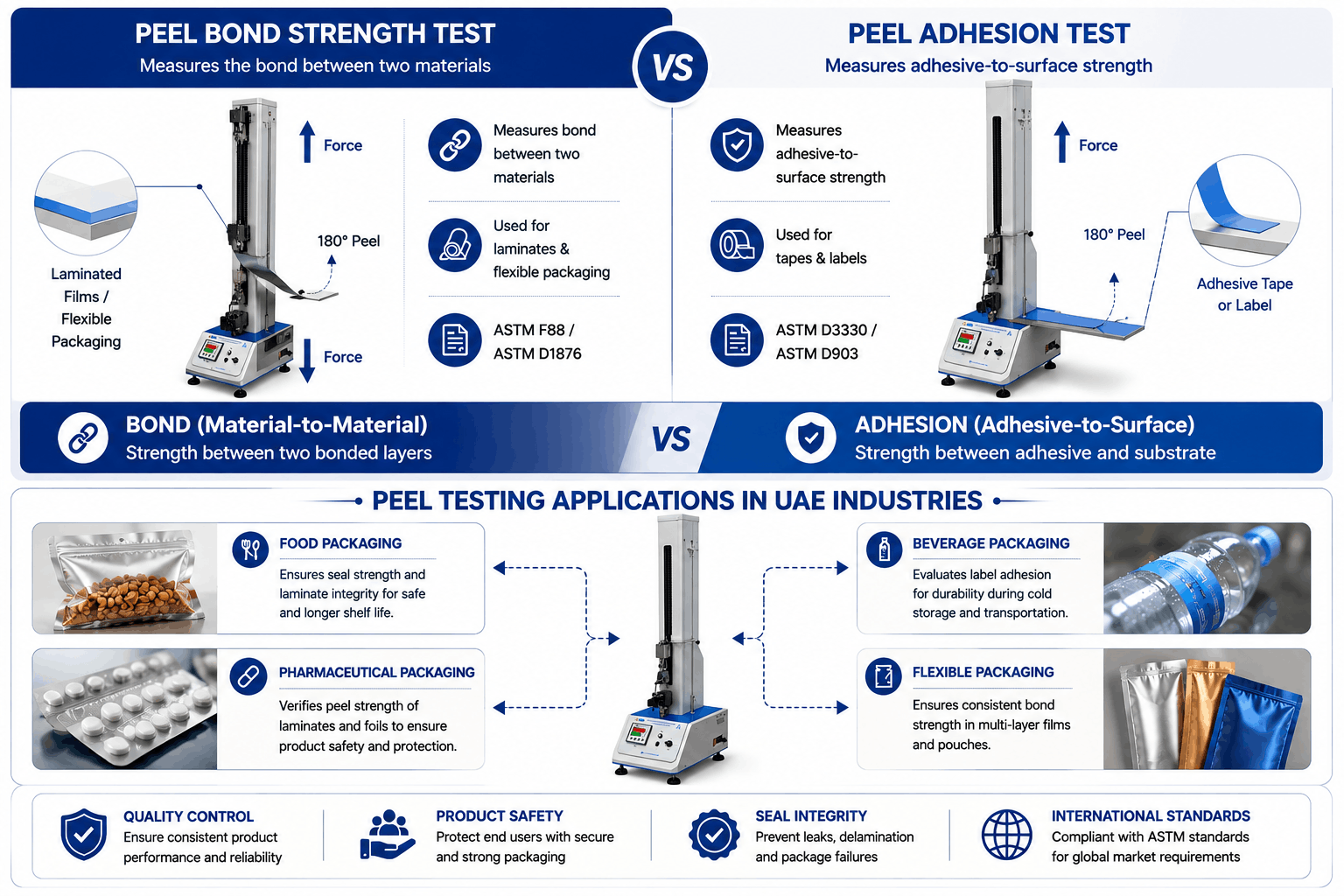
When we do peel bond strength testing, we are looking at a category that includes lots of things, like laminates and seals and coatings and all kinds of composite bonds.
Standards used. Peel bond strength tests are typically run to ASTM F88, ASTM D1876 (T-peel), or ISO 8510. Peel adhesion tests are typically run to ASTM D903.
When we do a test on a substrate, we are looking at how things stick together. The peel bond test is a way to see how strong the bond is between two things that are stuck together. This can be a film stuck to a foil, a film stuck to another film, or a laminate stuck to itself.
The peel angle is important. Peel bond tests use the angle that works best for the material and the standard. For peel adhesion tests, the angle is fixed. It is usually 90° or 180°.
A modern peel bond strength tester, which is also known as a peel tester machine or a peel seal strength tester, is made up of several parts. The peel bond strength tester usually has the following parts:
1. When you use a load cell, it measures the force that is applied during peeling. This force can be very small, like 0 to 50 N, for things that're delicate. It can also be a lot stronger, like 2500N, for things that need more force. The load cell range is chosen based on the peeling task that needs to be done.
2. The motorized crosshead is what pulls the sample apart. It does this at a speed that you can set. Speed can be adjusted to fit other standards for the motorized crosshead.
3. Sample grips or peel fixtures are used to hold the specimen at the angle. These fixtures keep the specimen at a 90-degree angle or a 180-degree angle while you are pulling on the sample. Some machines have a part that moves back and forth to keep the peel angle of the sample the same as you pull on it.
4. Software/data logger. It records force versus displacement. This tool calculates the peel force and peak force. It also generates reports that say pass or fail based on the standard you choose. These reports are about force versus displacement.
The test cycle works like this:
A sample strip is cut. It is usually 15mm or 25mm wide. One end of the strip is clamped in the grip. The machine then pulls the strip at a speed. The force applied is recorded as a curve. This continues until the strip is fully separated or a certain pull length is reached.
The United Arab Emirates has a lot of manufacturing and shipping businesses. These are in places like Jebel Ali, Dubai Industrial City, KIZAD in Abu Dhabi, and Sharjah's industrial zones. The United Arab Emirates' manufacturing and shipping businesses rely heavily on peel testing. Peel testing is used in different areas of the United Arab Emirates' manufacturing and shipping businesses.
A lot of manufacturers for peel bond strength testers in the UAE are available. They do these tests after they have made something sit in temperatures for a long time or after it has been made to go through a lot of heat. This is because UAE manufacturers want to make sure the glue is strong.
If you are ready to get one, contact Presto at +91 9210 903 903 or info@prestogroup.com.
If you're evaluating suppliers or a peel bond strength tester manufacturer in the UAE or comparing a peel bond strength tester supplier in the UAE against imported options, consider the following:
1. Standards compliance — Confirm the machine explicitly supports ASTM F88, D903, D1876, and ISO 8510 out of the box, not just "peel test capability."
2. Load cell range and accuracy — A single fixed-capacity load cell rarely covers both thin-film packaging and rigid laminate testing well. Look for interchangeable load cells.
3. Calibration and traceability — Ensure the supplier offers UAE-based calibration support traceable to national or ISO-accredited standards, since imported machines often need local recalibration and service support.
4. Software and reporting — Automated pass/fail reporting against selected ASTM/ISO methods saves significant QC time, especially for export documentation.
5. After-sales service — Local presence for spare parts, load cell recalibration, and software updates matters more in the UAE than the sticker price, given import/shipping lead times for replacement parts.
6. Price positioning—Peel bond strength tester price in the UAE and peel tester machine price in the UAE vary widely based on load capacity, standard compliance, and whether the unit is a basic manual peel tester or a fully automated, software-driven universal testing machine (UTM) configured for peel testing. Expect entry-level manual/motorized peel testers at the lower end and multi-standard automated UTMs at the higher end.
Yes. Most universal testing machines are really good at doing different types of tests. They can do this because they have tools like peel fixtures and a load cell. To make it work, you just need to change the setup of the machine, the way it peels, and some other settings in the software. You do this based on the material you are testing and what you are using it for. You can use the universal testing machine for these tests by adjusting a few things like the fixture and the angle at which you peel. This makes universal testing machines very useful for testing materials and applications.
The type of material is what matters. If you are dealing with flexible films, you will need load cells that can handle 0 to 50 newtons or 0 to 100 newtons to get accurate readings when you are not using a lot of force.
The cost of something is based on what your machine's capable of doing and how much work it can do automatically. What features it has. Manual testers are cheaper. Automated systems, with software that reports results, cost more. You should ask for a price based on what you need.
This really depends on the standard and the material that is being used. The type of configuration that is used depends on the type of packaging. For film-to-film seals, the 180° configuration is usually used. On the other hand, the 90° configuration is often used when one of the substrates is rigid. The ASTM F88 standard is important because it sets the rules for peel configurations, like the 90° and 180° configurations.
A lot of companies in the UAE that make things like to do tests to see how strong the glue is. They do these tests in a lab with temperature and humidity. They also do tests after they have made the glue really hot and humid for a while. This is to see what happens to the glue when it is stored or sent to places with hot and humid weather in the UAE.
Not exactly. A tensile testing machine is a machine. It is used for various types of tests. A peel bond strength tester is different. A special machine just for peel testing, or a tensile testing machine with special tools and settings for peel testing. These special tools and settings help it follow peel testing standards.
If you need to get a peel bond strength tester serviced or calibrated in the United Arab Emirates, you should look for people who sell or make these machines and have a service team in the United Arab Emirates. Your search must include a “peel bond strength tester supplier in UAE.
Related Blogs For Peel Tester Machine
Elevate your quality assurance process to new heights
At Presto, we take pride in being Global manufacturers of Laboratory Testing Instruments for different industries.