
01-Jun-2026
Presto Instruments
A fault, such as a broken plastic pipe in a construction project in Tanzania or an air leak in a rubber seal in industrial equipment in Mwanza—well, the problem always stems from the same point: materials that have not been tested correctly before their exit from the production line. Tanzania's manufacturing sector is growing fast — but growth without quality control is a risk no serious producer can afford.
That's where the tensile test equipment proves to be invaluable. A calibrated tensile testing machine can be one of the first lines of quality instruments that are necessary for any manufacturers using plastics or rubber in Tanzania, which distinguishes compliant, exportable products from materials that would fail in use.
In this guide, we will explain the importance, function, and international standards of tensile test machine technology for Tanzanian manufacturers and why Presto is East African Quality Teams’ preferred tensile strength tester manufacturer.
The tensile strength testing machine is a device that is used for pulling a test specimen of material until it becomes permanently distorted or breaks by a controlled and steadily increased pulling force. However, throughout the process, the machine measures the correlation between force and elongation and generates a stress-strain curve, which is a complete record of the mechanical personality of the material.
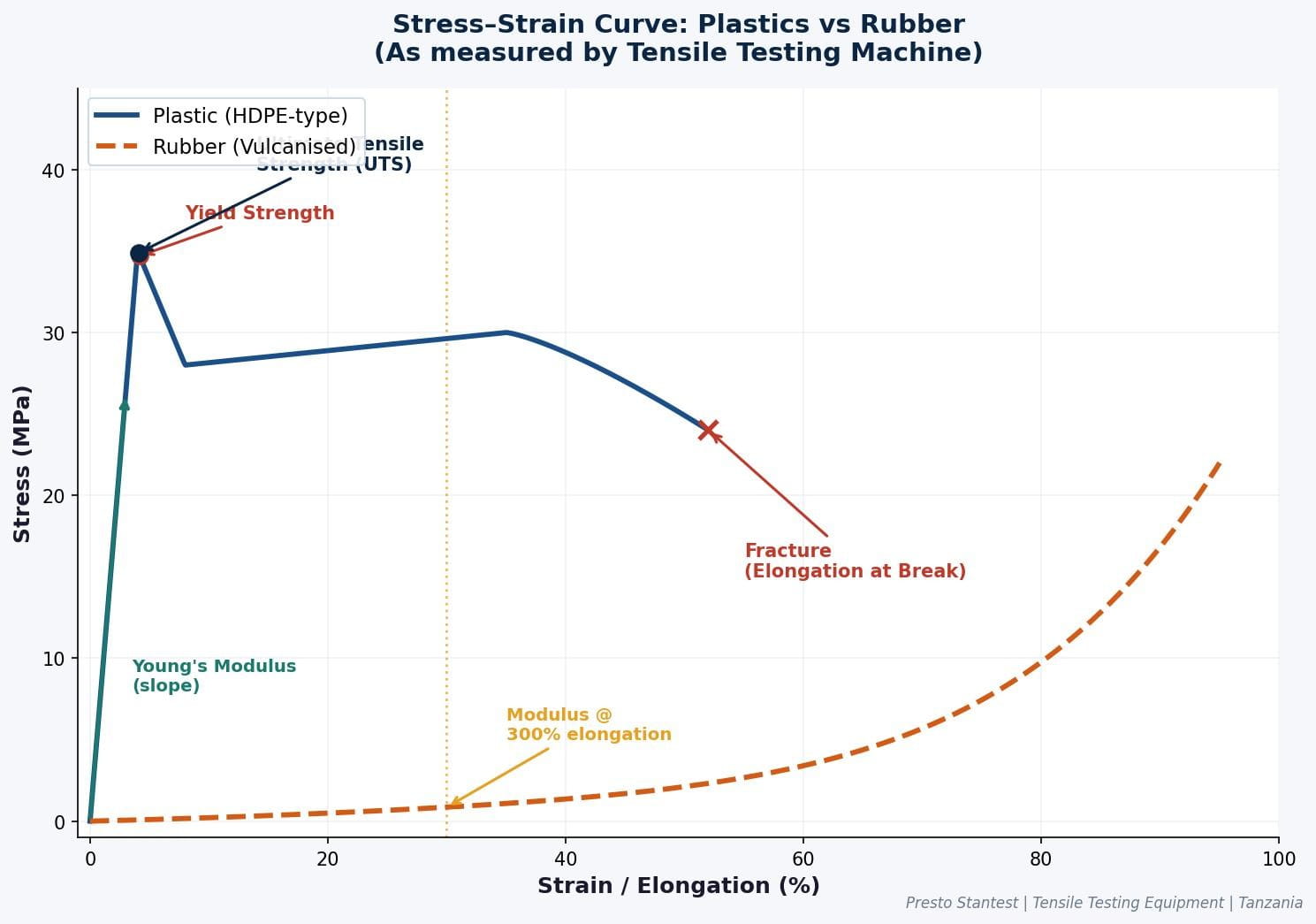
A tensile test machine provides important results such as
These figures are not abstract data points. They determine whether a polyethylene water pipe holds distribution pressure in Dar es Salaam, whether a rubber conveyor belt lasts a full operating season in a Tanzanian mine, or whether a flexible plastic film survives packaging line speeds without splitting.
The Tanzania Bureau of Standards (TBS) has the say in the quality of goods in the Tanzanian market as they rule in compliance with the Standards Act No. 2 of 2009. All plastic and rubber imported into Tanzania are subject to its Pre-shipment Verification of Conformity (PVoC) program, where all the goods should have a Certificate of Conformity before they can clear the port. For domestic producers, TBS certification — including the Tanzania Standards Mark of Quality — depends on documented, instrument-verified test data.
A manufacturer that cannot produce tensile results from calibrated tensile strength equipment in Tanzania will struggle to earn or maintain that certification — and in practice, this shuts doors to formal retail networks, government procurement contracts, and EAC export channels.
With the renewal of the EAC, Tanzania is able to access more than 300 million consumers in Kenya, Uganda, Rwanda, Burundi, South Sudan, and the DRC. Tensile test certificates are routinely demanded by buyers in these markets, especially the manufacturing and retail sectors in Kenya. However, until they have reliable tensile testing equipment and certifications, Tanzanian exporters still cannot be seen by quality-sensitive buyers in the region.
There are various sectors in Tanzania that are vulnerable to tensile failure of plastic or rubber components, but the following industries have potentially catastrophic consequences:
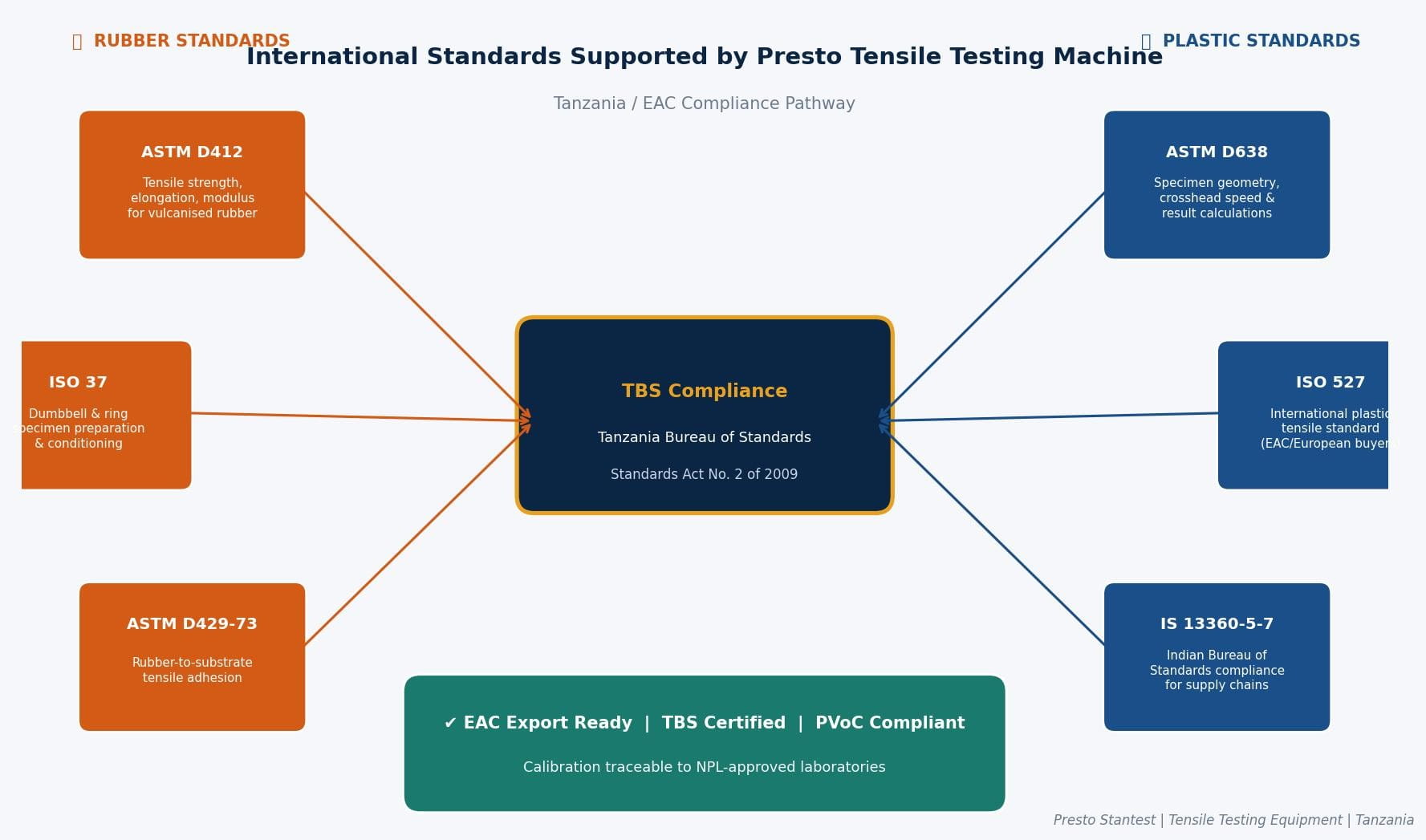
Performing a tensile test is only meaningful when it follows a recognized standard. The following are the internationally accepted frameworks that Presto's tensile strength testing machine is calibrated to support:
For rubber:
For plastics:
Manufacturers aligned to these standards can satisfy TBS auditors, third-party certification bodies, and international buyers—without repeating testing across different frameworks.
Presto Stantest is a world-renowned manufacturer of tensile strength testers, having decades of experience in developing precision testing instruments for the plastics, rubber, packaging, and textile industries. Full calibration certificates are provided by the Presto machines that are traceable to NPL (National Physical Laboratory)-approved laboratories; this is necessary for any results that will be submitted to TBS or to an international accreditation body.
The design of the tensile machine is based on the proven Constant Rate of Traverse (CRT) design, as is the machine in Tanzania, which was made by Presto. The bottom jaw moves downward at a precisely controlled, motor-driven rate; the top jaw stays fixed. This guarantees uniform, repeatable loading conditions, independent of human loading, for all tests and all operators.
Broad crosshead speed range—Speeds as low as 50 mm/min are possible for slow, steady pulls on rigid plastics under ASTM D638 conditions, and as high as 500 mm/min can be applied for rubber testing in accordance with ASTM D412 conditions.
Multiple capacity options—Presto comes in standard capacities of 250 kgf. Presto also has a tensile strength machine available in Tanzania with a capacity of 500 kgf and 1000 kgf, which can be customized to provide a capacity reaching 10,000 kgf for heavy industrial materials. This also implies that a one-time purchase request is adequate for your existing testing needs and will grow along with your production.
Interchangeable grip system—A vice-type grip system maintains a firm grip on rigid plastic specimens; rubber dumbbell specimens can be handled without pre-stressing by using roller grips, and pneumatic grips can be used for fragile or thin film specimens. The grip-to-grip separation range is from 25 mm to 700 mm.
WinTest data management software—All tests are recorded with sample ID, operator information, size of specimen, the standard used, and the date. Reports are immediately available for upload to QMS or regulators.
Competitive tensile strength tester price—Presto's direct manufacturer-to-buyer model helps to avoid intermediate markups, enabling Tanzimat Laboratories to obtain precision-grade tensile test equipment at a competitive price.
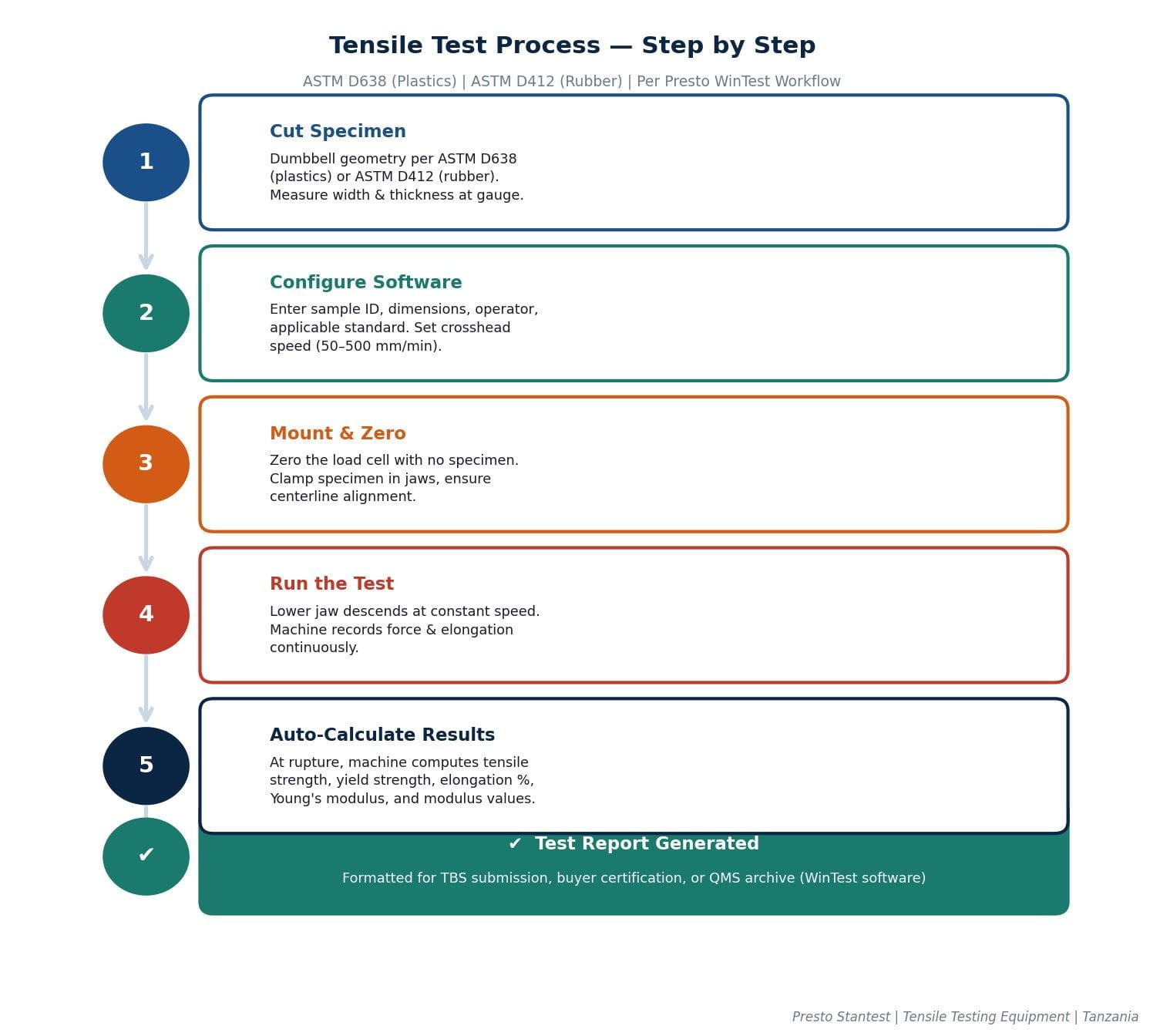
For quality teams commissioning Presto tensile strength equipment in Tanzania for the first time, the standard test sequence is as follows:
1. Specimen section it to the dumbbell shape called for by the appropriate test method (ASTM D412 for rubber or ASTM D638 for plastics) and measure the width and thickness of the gauge section.
2. Enter sample details into the Wintest software, select the target standard, and set the appropriate crosshead speed.
3. Zero the load cell with no specimen in place, then clamp the specimen between both jaws with care for centerline alignment.
4. Mark the gauge length, then start the test. The lower jaw descends at constant speed, applying continuous tension.
5. At rupture, the machine auto-stops, calculates tensile strength, yield strength, and elongation percentage, and generates a formatted test report ready for TBS documentation or buyer submission.
Tanzania's quality landscape is tightening. TBS enforcement is strengthening, EAC buyer expectations are rising, and the cost of a failed certification audit far exceeds the cost of getting testing right from the start.
A tensile testing machine from Presto Instruments in Tanzania is a direct investment in your market access, your brand credibility, and your customers' safety. A proven manufacturer of tensile strength testers in Africa and also in Asia, Presto, with its accuracy, standard compliance, and after-sales, is the perfect partner of Tanzimian manufacturers to stand head to head with their competitors.
Q. What are the differences between a universal test machine and a tensile test machine?
A universal testing machine (UTM) is used to conduct a tension test, compression test, flexure test, and peel test. A tensile test machine focuses on tension only. Presto has both options, and any tensile model may be upgraded with extra fixtures for use as a complete UTM.
Q. How much does a tensile strength tester's price typically range?
Tensile strength tester prices vary based on capacity, software capability, and grip configuration. Presto's entry-level 250 kgf digital model is designed for cost-effective entry into certified quality testing, while higher-capacity computerized models carry a higher investment.
Q. Does Presto supply tensile strength testers in East Africa?
Yes. Presto is the supplier of tensile strength equipment in Tanzania and East Africa in general, which is technically supported, calibrated, and provided with spare parts for its longevity.
Q. What materials can Presto's tensile strength testing machine be used for?
In addition to testing plastics and rubber, Presto can be used to test textiles, leather, films, adhesives, and foams, making it a great investment for testing multi-materials.
Elevate your quality assurance process to new heights
At Presto, we take pride in being Global manufacturers of Laboratory Testing Instruments for different industries.