
06-Mar-2026
Presto Instruments
The corrugated cartons will have the capacity to withstand pallet stacking, containerized export shipping, high humidity, and a long life span in the warehouses in the rapidly growing packaging industry in Indonesia. However, field failures still do take place: bottom cartons may crumble under the weight of stacking, sidewalls may flex in warm and wet conditions, and damages to the products result in the rejection of shipments.
The majority of such failures occur not only because of poor board quality but also because of poor compression validation or incorrect test data.
Without a calibrated and standards-compliant box compression test machine, manufacturers risk:
ASTM D642 defines the test method for determining the compressive resistance of shipping containers, components, and unit loads. The objective is to simulate vertical stacking loads experienced during warehousing and transportation.
The test evaluates:
The result is typically reported as peak compression strength (N or kN), which forms the basis for stacking calculations using McKee’s formula and warehouse safety factors.
For export shipments, buyers may also align testing with International Safe Transit Association stacking protocols or ISO 12048 compression methods.
Indonesia’s tropical humidity significantly affects corrugated board performance. Moisture reduces fiber bonding strength, leading to:
Conditioning samples per TAPPI or ISO humidity standards before testing is therefore essential for realistic performance evaluation.
A precision box compression strength tester ensures manufacturers quantify performance under controlled and repeatable conditions.
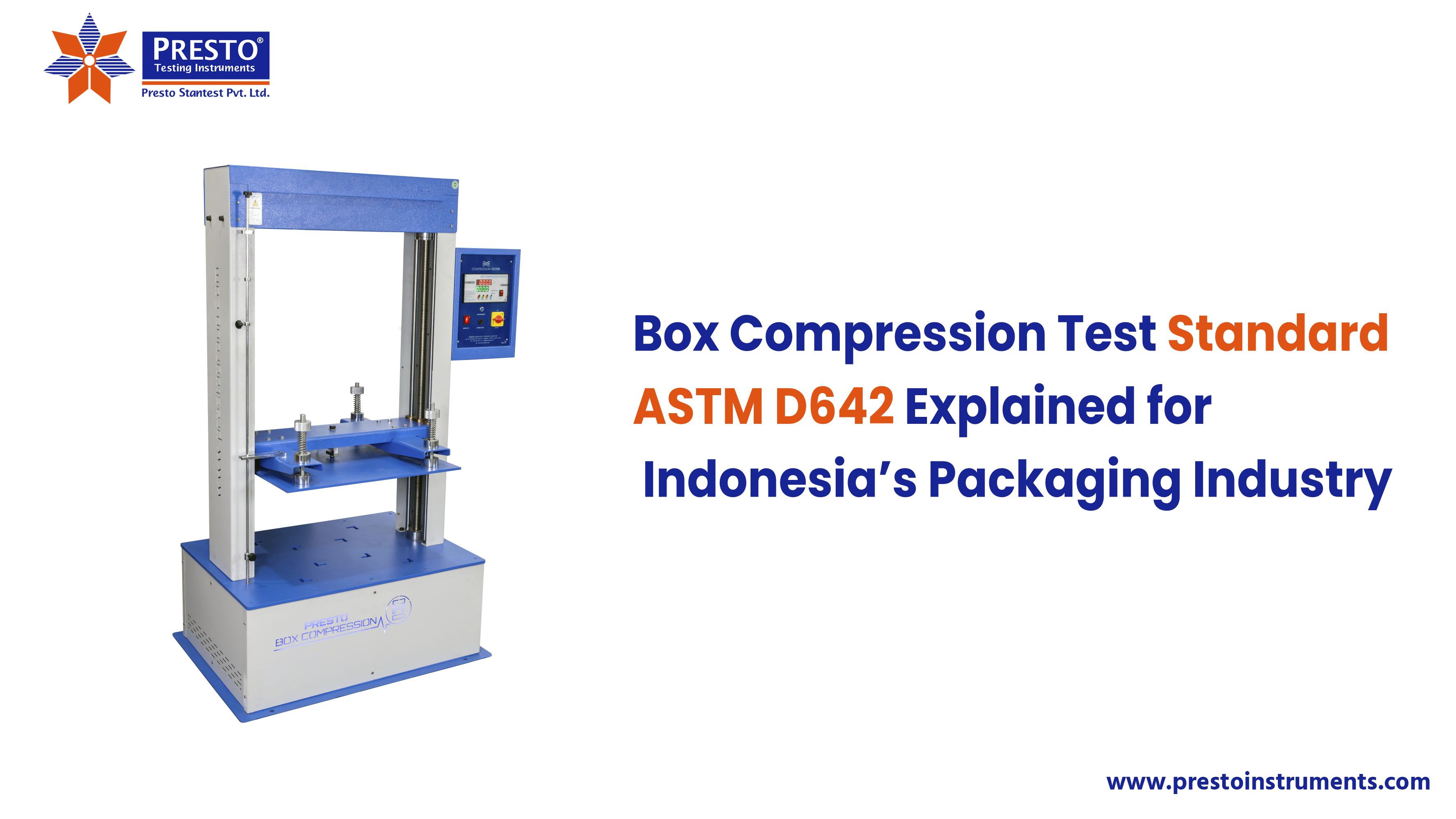
A box compression testing machine applies a uniform vertical compressive load at a constant rate as specified in ASTM D642.
Mechanical Structure
Test Procedure
Peak load before collapse represents box compression strength.
Maintaining platen parallelism is critical. Even minor angular deviation introduces eccentric loading, producing artificially low results.
A properly engineered BCT tester in Indonesia ensures minimal frame deflection and precise load application.
Understanding failure behavior improves packaging optimization.
1. Panel Buckling
Occurs when side panels lose stability under axial compression. Often linked to insufficient board stiffness or moisture absorption.
2. Column Collapse at Corners
Corners act as load-bearing columns. Weak flute bonding or poor adhesive application reduces corner strength.
3. Progressive Flute Crushing
Internal flute structure collapses gradually before visible external deformation.
4. Shear Failure at Glue Joints
Adhesive failure leads to sudden structural instability.
Analyzing load–displacement curves from a computerized box compression tester system helps distinguish gradual deformation from abrupt structural failure.
When selecting a box compression machine, QA managers and procurement teams should assess:
For audit readiness, a box compression tester supplier must provide traceable calibration certificates and uncertainty reports.
A box compression testing machine is essential for:
Corrugated Packaging Manufacturers
FMCG & Food Sector
Electronics & Appliances
Pharmaceutical Packaging
The instrument complements other material testing instruments such as edge crush testers and burst strength testers for comprehensive board characterization.
A reliable box compression tester manufacturer ensures alignment with:
True compliance requires:
Merely labeling equipment as “ASTM compliant” without mechanical validation is insufficient.
Presto Instruments engineers high-precision industrial testing machines designed for durability and measurement accuracy.
Engineering Integrity
Advanced Control Systems
Lifecycle Support
When evaluating box compression tester price, manufacturers should consider long-term measurement reliability, calibration stability, and service availability—not just the initial cost.
Presto’s solutions are engineered to support Indonesia’s packaging manufacturers serving India and global export markets.
Corrugated carton failure is rarely accidental—it is often the result of insufficient validation or inaccurate measurement.
Implementing a standards-aligned box compression test machine ensures:
For manufacturers seeking a reliable box compression tester supplier, Presto Instruments offers technically robust, calibration-backed solutions.
Contact Presto Instruments today to request a technical consultation or product demonstration.
FAQs
Moisture reduces fiber bonding strength, leading to lower compression performance.
It depends on carton size and stacking requirements; 5 kN–50 kN is common for most applications.
Typically annually or as defined by internal QA and export compliance policies.
Elevate your quality assurance process to new heights
At Presto, we take pride in being Global manufacturers of Laboratory Testing Instruments for different industries.