
06-May-2026
Presto Instruments
Why do plastic products fail to maintain consistency during production in the Oman industries? Many times, the issue is not with processing machines. It comes from variations in raw material flow behavior. Even small differences in melt flow can lead to defects, weak structure, or uneven finish.
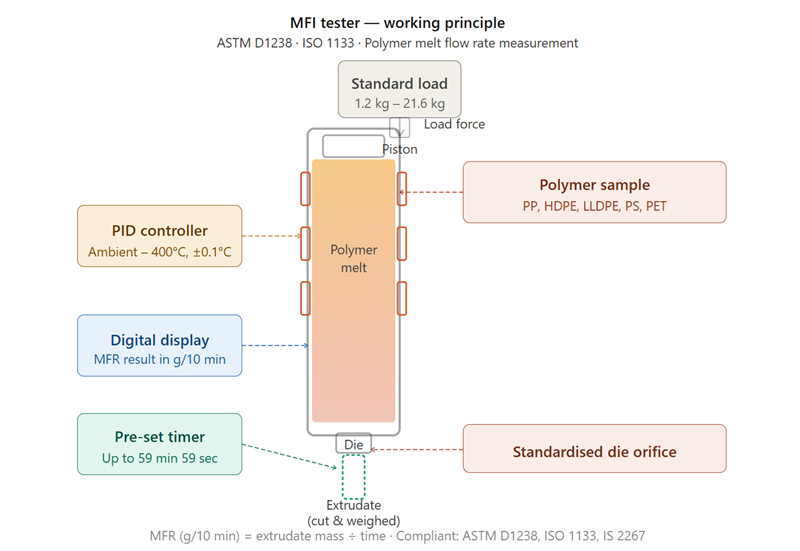
An MFI tester machine in Oman helps solve this problem by measuring how thermoplastic materials behave under heat and load. It provides a very clear picture of the flow of materials prior to any production commencing. This enables industries to make decisions and prevent serious mistakes that would cost them a lot.
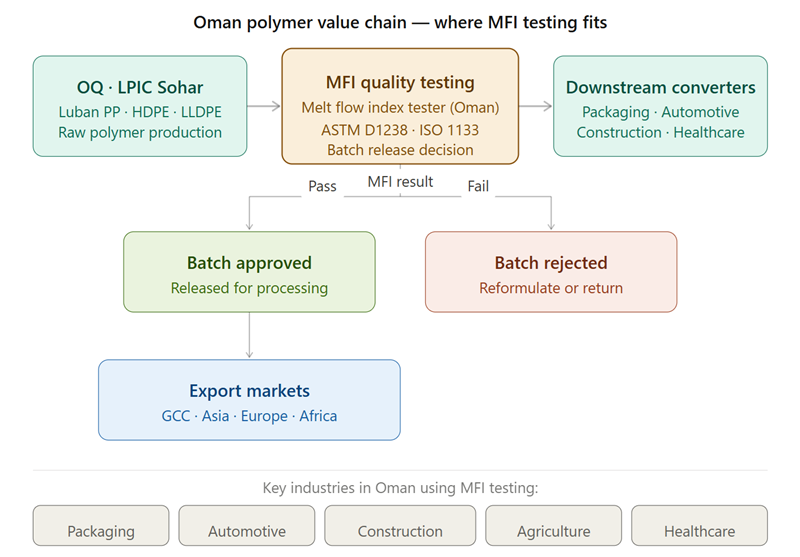
In the case of manufacturers in Oman, it is not only a technical decision to select the right melt flow index equipment. It is a strategic intervention that influences the quality of products, cost management, and performance in the long term. Knowing what the supplier can achieve, what factors can drive the cost of a product, and what a machine can actually accomplish serves as a useful, continuous reminder on making a well-informed investment.
Selecting a trusted MFI machine supplier in Oman is one of the most important decisions for any testing lab. The supplier is the direct player in the determination of how easily the machine will work in the long run.
Working with an experienced melt flow index tester manufacturer and supplier helps the Oman industries maintain stable testing performance and avoid operational disruptions.
The MFI tester price in Oman varies based on several technical and operational factors. Understanding these helps buyers make a better investment decision.
While a lower price may seem attractive, investing in a high-quality Melt flow Index tester machine in Oman reduces long-term costs related to maintenance, errors, and downtime.
Testing without standards can lead to inconsistent results. The same material may produce different values if testing conditions are not controlled.
Standards define how melt flow testing should be performed. They guide temperature settings, load conditions, and sample preparation methods.
Following these standards helps industries maintain consistency in testing results. It also makes reports acceptable to international buyers.
A proper MFI testing machine in Oman should support these standards. This assists in producing proper and comparable outcomes when comparing the results of various labs and batches.
The environmental conditions have a key role to play in the melt flow tests. Lab temperature and humidity may influence material properties prior to testing.
Maintaining controlled lab conditions helps the Oman industries achieve reliable and repeatable results. It also improves confidence in testing data.
Machine stability is critical for accurate melt flow testing. Any vibration or structural weakness can affect measurement precision.
The selection of a robust MFI tester machine in Oman can assist industries to ensure the accuracy of the testing procedure and prevent unnecessary losses associated with downtime.
Ease of use is an important factor in daily lab operations. Complex systems can increase training time and lead to operational errors.
Selecting a melt flow index machine with intuitive operation improves efficiency and reduces chances of mistakes.
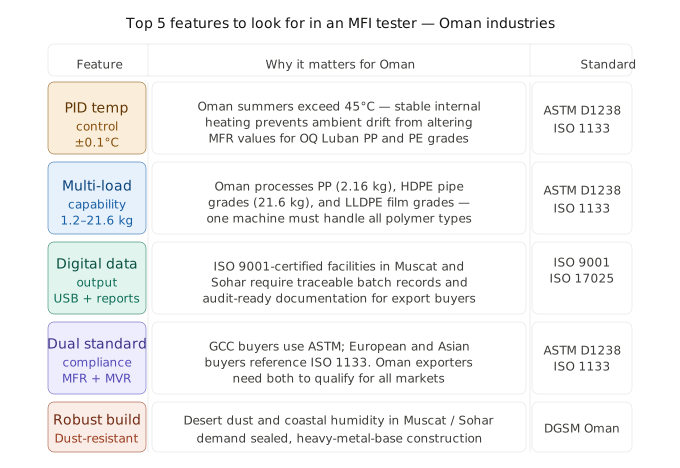
Based on the requirements of Oman's polymer, packaging, automotive, and construction industries, here are the five most critical features to evaluate when selecting a melt flow index tester:
Feature 1: Precise PID Temperature Control (±0.1°C)
With the heat and humidity in Oman, it is imperative that the temperature control inside the machine be extremely stable. Consider a microprocessor-controlled, ambient-to-400°C, PID controller with a resolution of 0.1°C, which is important to accurately test an OQ Luban PP, HDPE, or LLDPE grade according to ASTM D1238 and ISO 1133 conditions.
Feature 2: Multi-Load Capability
Oman's diverse polymer processing sector requires testing materials from polypropylene (2.16 kg load) to high-viscosity HDPE pipe grades (21.6 kg load). A machine supporting the full range of standard test weights provides flexibility to handle all polymer types produced locally or imported from global suppliers.
Feature 3: Digital Display with Data Storage and Reporting
ISO 9001-certified facilities in Muscat and Sohar need to have a documented testing record. A modern MFI tester machine in Oman should offer digital data storage, USB connectivity for PC download, and automatic report generation—supporting traceability and audit compliance.
Feature 4: ASTM D1238 and ISO 1133 Dual Standard Compliance
Dual standard (in place of a single standard) compliance is crucial as Omani manufacturers cater to both the GCC markets (which often adopt the ASTM standard) and to European or Asian buyers (who adopt ISO 1133). It should be able to measure also MFR (mass flow rate) in addition to MVR (volume flow rate).
Feature 5: Robust, Dust-Resistant Build Quality
Equipment in industrial and semi-arid areas in Oman is required to tolerate the presence of small dust and the high ambient temperatures as well as humidity changes. Certain features make a difference in being a good melt flow index machine manufacturer: the heavy-gauge metal base plate, sealed barrel, and tough construction are vital to ensure reliable, long-lasting operation in Oman.
Choosing the right partner is the most important thing, as well as choosing the right machine. Presto Laboratories is a reputed organization that offers quality testing solutions that are designed to be utilized for industrial testing and permanent use.
Presto Laboratories, with its strong presence in the global market, serves all industries in need of reliable testing solutions. Their service and dedication to quality require them to be a choice of the melt flow indexers in Oman.
1. What is the typical frequency of an MFI tester machine in Oman to be calibrated?
Calibration is performed after every six to twelve months due to the variation in the calibration and hence might vary with the frequency and standard of use within a laboratory.
2. What are the materials that can be tested by using a melt flow indexer in Oman?
It is primarily applied to thermoplastics such as polyethylene, polypropylene, and polystyrene to measure the flow behavior prior to processing before commencing production processing.
3. Why is temperature control critical in MFI testing machines in Oman?
Temperature control is accurate to ensure consistent behavior of the material in the testing process, since slight changes in temperature can alter the values of melt flow considerably.
4. Does a melt flow index tester allow comparisons across materials of different suppliers?
Yes, it assists in the assessment and comparison of the raw material consistency so that the procurement teams can use the performance information to select the suppliers.
5. How does a melt flow rate differ from a melt volume rate?
The melt flow rate is used to measure mass flow with time, while the melt volume rate measures volume flow, both of which describe processing characteristics.
6. What would be the benefits of automation in the case of melt flow index testing?
Automation enhances repeatability, minimizes manual error, and can be accomplished faster, which is particularly beneficial in instances that involve a concerned laboratory with a significant amount of samples to process.
Elevate your quality assurance process to new heights
At Presto, we take pride in being Global manufacturers of Laboratory Testing Instruments for different industries.