
11-May-2026
Presto Instruments
Brazil is one of the world's biggest and most developed polymer industries. Polymer processing is of great importance for the Brazilian industry in various sectors, such as the production of petrochemicals, automobiles, packaging, agricultural plastics, health, and consumer goods. The major manufacturing centers, such as those located in Sao Paulo, Campinas, Curitiba, Porto Alegre, Rio de Janeiro, Manaus, and Camacari, rely strongly on regular quality control of polymers in their daily routine.
The Melt Flow Index (MFI) is among the most crucial quality parameters in the plastics manufacturing process. MFI testing is one test that assists manufacturers in assessing how the molten thermoplastic will flow when subjected to a set temperature and load conditions. The precise MFI data allows the grading of resins, process control, product quality control, and conformance with ISO 1133, ASTM D1238, and ABNT NBR testing standards.
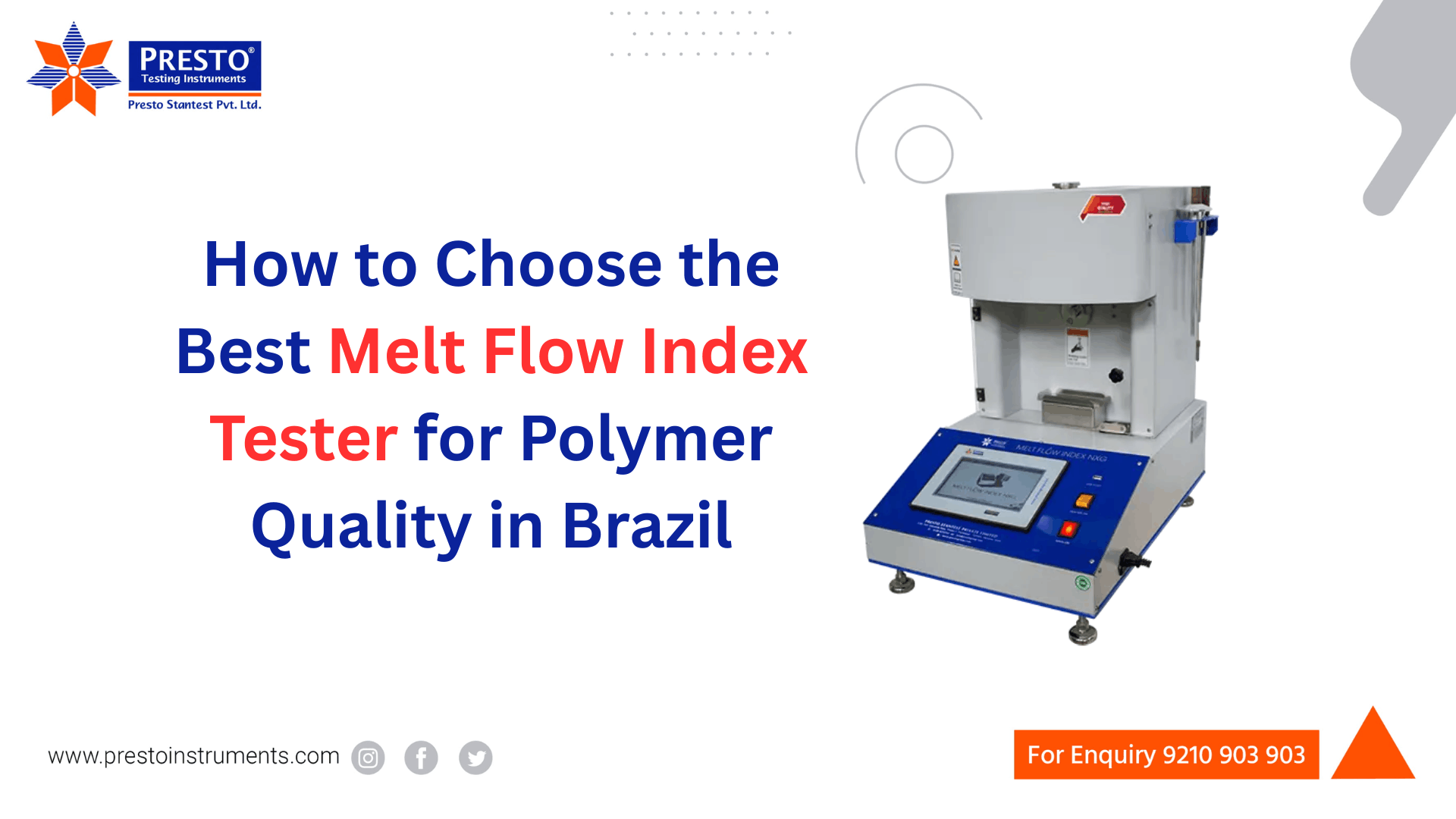
Presto Instruments has a full line of MFI testers for polymer laboratories in Brazil, designed to help industries choose the appropriate testing solution for their type of polymer, volume of testing, reporting needs, and production applications.
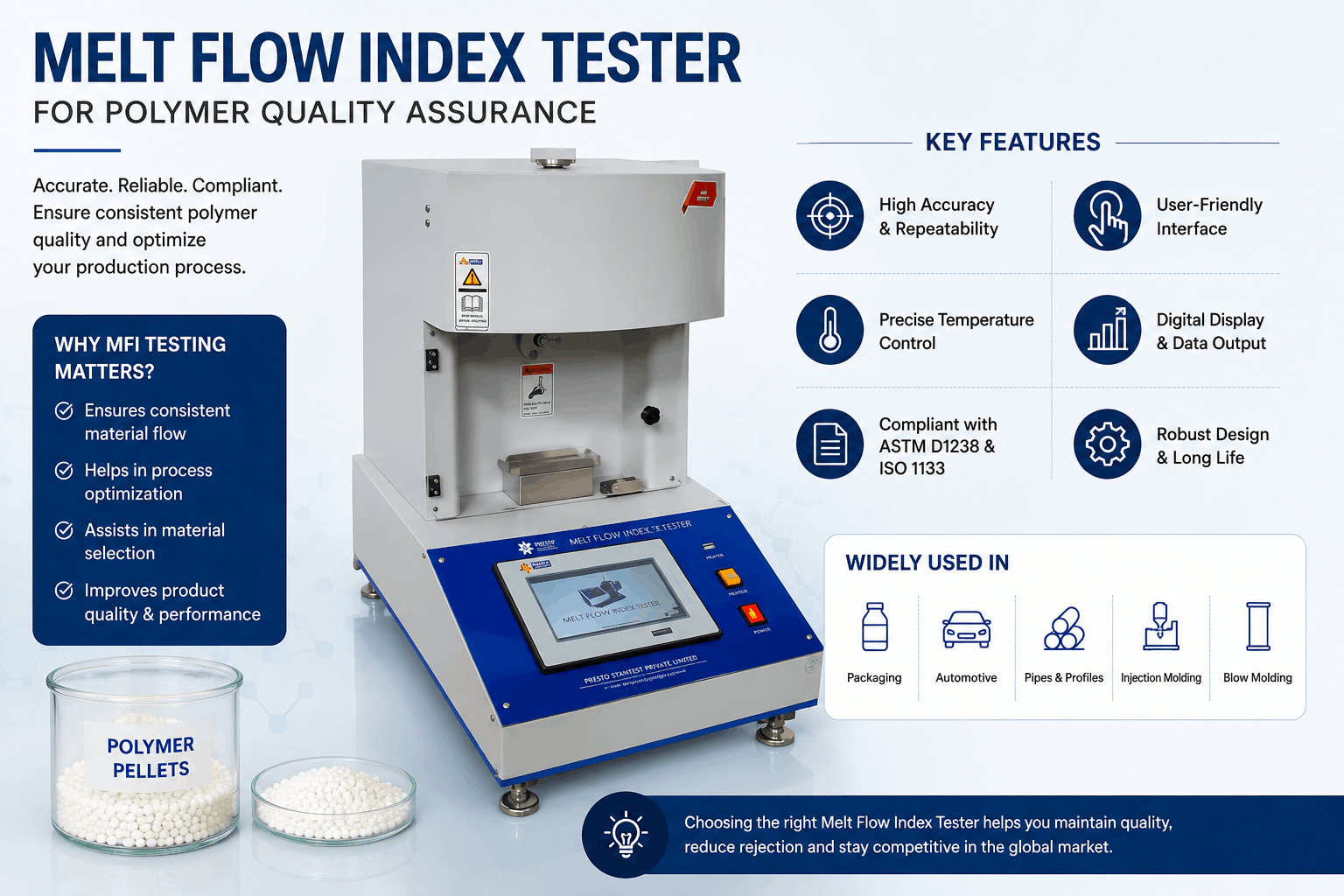
Melt Flow Index, or Melt Flow Rate (MFI), in the plastics or polymer industry is one of the crucial quality measurements. Measures the flowability of a thermoplastic material when it is molten, using parameters of controlled load and controlled temperature and a standard die. This is reported as grams in 10 minutes (g/10 min) and is used by the polymer manufacturing companies as an indicator of polymer processing behavior and material consistency.
During an MFI test using an MFI testing machine, the polymer is heated to a defined temperature, a standard weight is added on top, and the volume of molten polymer in the given time that flows through the die is measured. The typical test standards are ISO 1133, ASTM D1238, and ABNT NBR 7402, commonly applied at polymer laboratories in Brazil.
More exact MFI data for Brazilian manufacturers is important for resin grading, injection molding, blow molding, and film production, as well as verification of raw materials. It is also used to ensure the maintenance of product quality in the industries and their processing in accordance with the domestic as well as international quality standards.
The Brazilian polymer and plastics market is one of the most varied and of industrial importance in the world, being used in these sectors:
Petrochemical Industry
Brazil has a significant oversupply of polyethylene, polypropylene, PVC, and specialty polymers. In application, Melt Flow Index testing is performed by resin manufacturers and compounders to ensure batch consistency, resin grading, and resin processing characteristics before the resins are sent to industries downstream.
Automotive Sector
Engineering plastics' use for bumpers, interior trims, dashboards, and under-the-hood parts in Brazil's automotive industry is so extensive that it has boosted business growth. By using MFI testing, manufacturing companies can ensure the consistency and quality of their injection molding products and meet the automotive production standards.
Packaging and Flexible Films
MFI testing of polyethylene films, PET bottles, BOPP packaging, and rigid containers is used by packaging manufacturers. Melt flow data provides accurate information for film thickness, sealing, mechanical strength, and consistent quality in the package-making process.
Agricultural Plastics
Irrigation pipes, greenhouse films, agrochemical containers, and silo bags are tested by MFI for agricultural industries. The test helps evaluate and assess polymer processing behavior and material durability of the product under severe field conditions.
Medical, Pharmaceutical, and Healthcare
MFI testing is utilized by the healthcare and pharmaceutical sectors for medical packaging, syringes, IV parts, and polymer healthcare products in Brazil. Testing according to ISO 1133 for material verification and for the documentation for regulations.
Presto Instruments manufactures a comprehensive range of five melt flow index testers covering every laboratory requirement from basic incoming material inspection to advanced research and development applications. Let's now take a detailed look at each of these models:
The Presto MFI Junior is an entry-level model designed for simple and accurate melt flow testing of thermoplastic materials. It meets both ISO 1133 and ASTM D1238 testing requirements, has a manual weight loading system, and is very easy to operate in the lab.
Ideal for low-volume quality checks, educational labs, and small polymer processors.
The Presto MFI Deluxe offers improved testing precision with digital temperature control and stable testing conditions for routine polymer quality analysis. Polyethylene, polypropylene, ABS, and PVC—all types of polyethylene material testing can be performed on them daily, and they are commonly used material test modes.
Recommended for: packaging manufacturers, polymer processors, and medium-volume quality control laboratories.
The Presto MFI NEO 2.0 features a touchscreen interface, data logging, printable reports, and advanced digital controls for traceable polymer testing operations. It facilitates quality-system-documented laboratories.
Ideal for: It is suitable for an automotive polymer lab, a pharmaceutical packaging plant, and an engineering plastics testing facility.
The NXG Model is the next generation advanced smart testing system, which features automatic cutting, real-time data analysis, PC connectivity, and supports ISO 1133 Method A & Method B testing requirements.
Ideal for: Petrochemical laboratories, research centers, and polymer testing facilities with a significant volume of polymer output.
The Presto MFR-MVR model offers two-in-one testing with melt flow rate and melt volume rate testing. The instrument supports advanced polymer analysis and detailed flow property evaluation.
Ideal for: advanced polymer processing industries, masterbatch manufacturers, exporters, and research laboratories.
Selecting the right Melt Flow Index machine from Presto's five-model range requires systematic evaluation of five key criteria:
What Polymer Types Do You Test?
All Presto MFI models are suitable for testing standard polymers, like polyethylene and polypropylene. The advanced models with increased temperature resistance are needed for engineering plastics such as nylon, polycarbonate, and specialty polymers (NEO 2.0, NXG, and MFR-MVR).
Which Test Standard Must You Comply With?
All the Presto MFI testers meet ISO 1133 and ASTM D1238 specifications. The MFR-MVR model should be chosen if both MFR testing and MVR testing are required in a lab. When testing with Method A and Method B, model NXG and MFR-MVR are recommended.
What Is Your Daily Test Volume?
Junior and Deluxe models suit low-volume laboratories. NEO 2.0 supports medium-volume testing with digital reporting. NXG models are ideal for productive, high-volume petrochemical and polymer production laboratories.
What Reporting Features Do You Need?
If advanced laboratories use any of the ISO 9001, IATF 16949, or ANVISA systems, they might demand touch screen controls, printable reports, graphical connectivity, and traceable records that can be found in higher-end Presto models.
What Is Your Budget in BRL?
Presto Instruments provides various price band options, allowing the choice of the proper MFI testing system based on technical needs and laboratory spending in accordance with the applicable inspection program.
Presto Instruments has over 30 years of experience in the production of melt flow index testers for polymer industries around the world. Brazilian manufacturers, processors, and quality laboratories prefer Presto for accurate testing, complying with international standards, and full technical assistance.
Improper melt flow index testing can be detrimental for the polymer industry in Brazil, both for ensuring consistent polymer product quality and for controlling the polymer processing. Whether it is the manufacturing of petrochemical resin, automotive molding, or packaging of pharmaceutical drugs or agricultural plastics, reliable MFI testing is an essential part of day-to-day laboratory operations. Presto Instruments has a full line of melt flow index testers available to meet the needs of various production volumes, requirements, and budgets. The models, from the economical MFI Junior to the advanced MFR-MVR dual-output system, allow those Brazilian laboratories to go for the right model for precise polymer flow analysis. For technical assistance, help in model selection, and customized quotations for the polymer testing laboratory in Brazil, please get in touch with Presto Instruments.
1. What is the application of a Melt Flow Index Tester?
A melt flow index tester in Brazil measures molten polymer flow properties under controlled temperature and load conditions for polymer quality control, material verification, resin grading, and process consistency testing in Brazilian industries.
2. What are the applications of melt flow index testing in Brazil?
In Brazil, Melt Flow Index testing is used for raw material inspection, production monitoring, process control, and evaluation of the quality of finished products in the petrochemical sector, packaging sector, automotive industry, agricultural plastics, medical devices, and pharmaceutical industry.
3. Which Presto MFI tester model is suitable for routine testing?
The Presto MFI Deluxe and NEO 2.0 models are suitable for routine polymer laboratory testing, offering accurate temperature control, repeatable performance, touchscreen features, and compatibility with ISO and ASTM testing standards.
4. What are the guidelines adhered to by the testers of Presto MFI?
Presto Melt Flow Index Testers meet the requirements of ISO1133 and ASTM D1238, which are recognized in polymer laboratories in Brazil for testing the thermoplastic materials for quality control processes, regulation documentation, and tests.
5. What are the differences between MFR and MVR testing?
MFR is the mass flow of molten polymer, whereas MVR is the volumetric flow. Both testing methods help laboratories evaluate polymer processing behavior, density characteristics, and material performance under controlled conditions.
Elevate your quality assurance process to new heights
At Presto, we take pride in being Global manufacturers of Laboratory Testing Instruments for different industries.