
14-Mar-2026
Presto Instruments
Cap failures in glass bottles rarely occur in isolation. When a crown cap dislodges during pallet stacking or a lug cap loosens under carbonated pressure, the immediate cost is product loss. The larger cost is brand damage, regulatory scrutiny, and export rejection.
In South Africa’s beverage, pharmaceutical, and food-processing industries, cap retention strength is a measurable engineering parameter—not a subjective quality check. However, in most cases, torque checks are used by themselves in a wide variety of facilities, and it is presumed that application torque will assure sealing integrity. It does not.
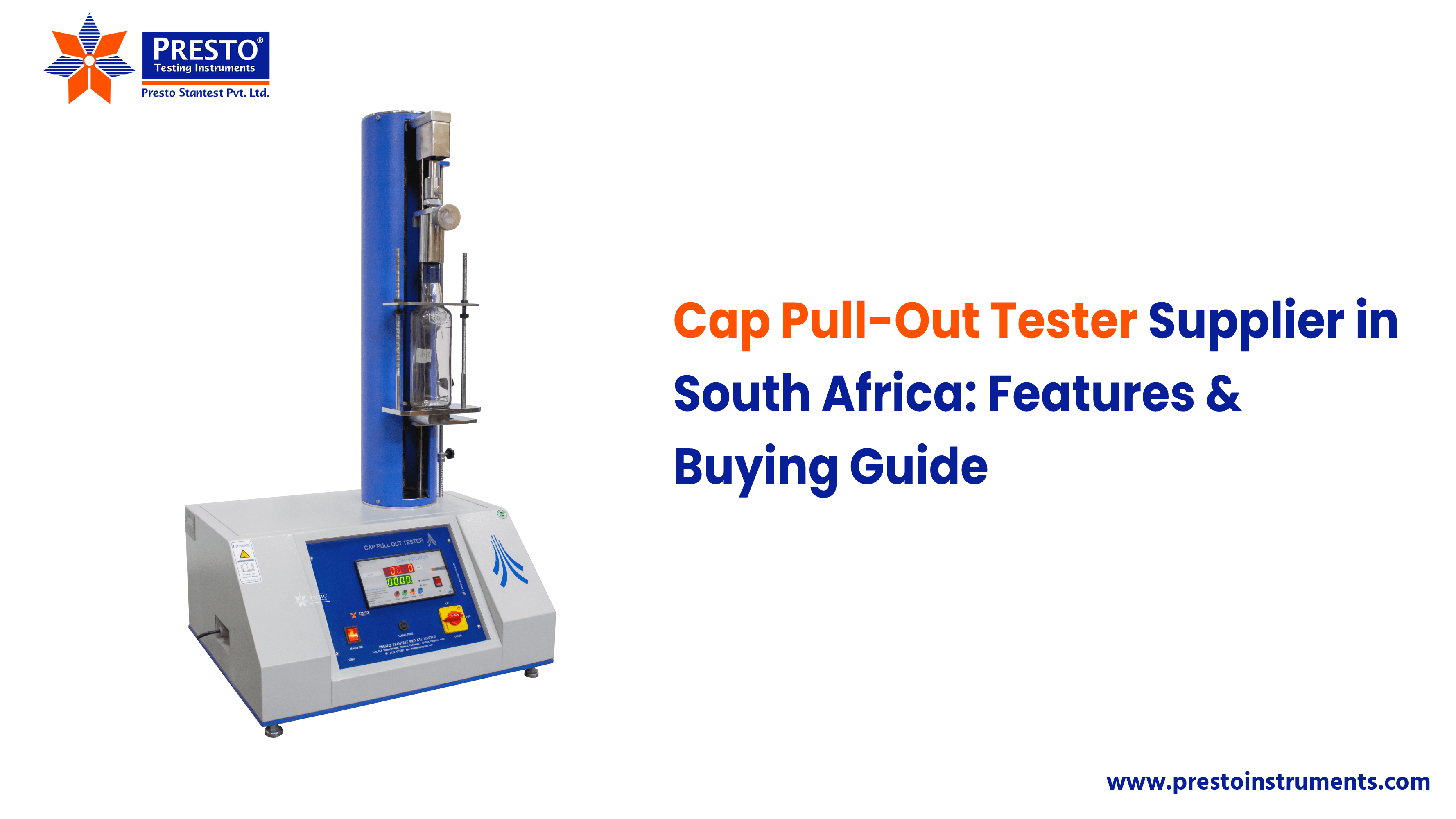
A Cap Pull-Out Tester is a precision tensile testing system designed to measure the maximum axial force required to detach a cap from a bottle under controlled loading conditions.
Unlike torque testers, which measure rotational resistance, pull-out testing directly evaluates the mechanical retention strength between cap, liner, and bottle finish. This makes it particularly relevant for:
It is widely used as part of packaging validation protocols in South Africa’s export-oriented manufacturing sector.
1. Carbonation Pressure and Axial Load
In carbonated beverages, internal CO₂ pressure generates upward axial force on the closure. If retention force is marginal, vibration during transport compounds the risk of cap displacement.
2. Glass Finish Variability
Minor dimensional variation in the bottleneck finish—diameter, bead height, thread profile—directly affects engagement strength.
3. Sealing Liner Performance
Liners that are viscoelastic are time-dependent. Under sustained load, creep can reduce retention strength.
The variables are measured by pull-out testing under a set of standardized conditions, which justifies the adherence to the recommendations of
Although not always tied to a single dedicated ASTM test number, pull-out evaluation supports overall packaging mechanical integrity standards.
The system operates on a controlled tensile loading mechanism with closed-loop force monitoring.
Structural Components
Technical Operation
1. The bottle is secured in a fixed lower fixture to prevent tilting.
2. The cap is gripped concentrically to ensure pure axial loading.
3. The crosshead applies tensile force at a constant, preset speed.
4. The load cell records force continuously until cap separation.
5. Peak force (N or kgf) is displayed and logged.
Controlled crosshead speed is essential. Too high a loading rate increases apparent strength due to viscoelastic stiffening of liners. Too slow a rate may exaggerate creep-related reduction in retention.
Frame rigidity is equally critical. Excessive structural deflection absorbs applied energy, leading to inaccurate readings.
A precision cap pull-out tester enables systematic identification of failure modes.
1. Cap Skirt Yielding
Plastic deformation of the skirt before detachment indicates improper crimp geometry or material softness.
2. Liner Adhesion Failure
In case the liner should detach from the cap instead of the cap becoming detached from the bottle, then adhesive bonding is not enough.
3. Glass Finish Fracture
In extreme cases, the bottleneck fractures before cap removal—suggesting over-crimping or glass brittleness.
4. Thread Stripping
In threaded closures, failure may occur due to shear stripping of bottle threads rather than axial disengagement.
Each failure type provides actionable insight into upstream production parameters.
For pull-out testers for glass bottle caps, alignment precision prevents bending stresses that can misrepresent actual axial strength.
When selecting a cap pull-out tester supplier, technical assessment should include:
The data acquisition rate should be sufficient to capture sudden peak loads accurately, especially in brittle detachment scenarios.
A cap pull-out tester supports:
Beverage Industry
Pharmaceutical Sector
Tamper-evident closure testing
Food Packaging
Export Compliance Testing
Integration with other material testing instruments—such as torque testers and burst testers—provides comprehensive closure performance analysis.
Packaging audits increasingly demand documented mechanical validation. Systems aligned with calibration practices recognized by:
Routine verification of load cell accuracy and crosshead displacement ensures measurement integrity over time.
Why Choose Presto Instruments as Your Cap Pull-Out Tester Supplier
Presto Instruments engineers high-rigidity industrial testing machines designed for repeatability and long-term stability.
Engineering Design Focus
Custom Fixture Solutions
Technical Support
For South African manufacturers supplying both domestic and export markets, measurement reliability and documented traceability are operational necessities.
Cap integrity cannot be validated by torque measurement alone. Axial retention force must be measured under controlled tensile conditions.
A precision cap pull-out tester delivers:
When you are considering a cap pull-out tester supplier in South Africa, then contact Presto Instruments in order to obtain the detailed specifications, a consultation, or an actual demonstration of the product.
FAQs
Q. Does loading speed affect pull-out strength?
Ans. Yes, viscoelastic liners respond differently at varying strain rates.
Q. Can the tester handle different closure types?
Ans. Yes, with interchangeable fixtures.
Q. Why is frame rigidity important?
Ans. Excess frame deflection reduces measurement accuracy.
Elevate your quality assurance process to new heights
At Presto, we take pride in being Global manufacturers of Laboratory Testing Instruments for different industries.