
14-Jan-2026
Presto Instruments
Do you think how manufacturing units know whether a material will stretch, break, bend, or hold its shape under pressure?
A UTM machine helps manufacturers to know the reaction of a material when kept under extreme pressure. In South Africa, testing accuracy is important for manufacturing, research, and quality checks. Selecting the right UTM is not only about cost. It is about matching the machine with real testing needs and long-term usage.
This blog explains what a UTM machine is, which standards it follows, its main features, available types, and how to choose the right model. You will also learn why Presto is often chosen by testing labs and industries. The discussion naturally covers aspects linked with the UTM Machine Price In South Africa, so that decision-making becomes easier.
Introduction
Material testing forms the base of product quality. Whether the work involves metals, plastics, rubber, textiles, or composites, knowing how a sample behaves under force is essential. A Universal Testing Machine applies controlled force and records how the material reacts. The data helps engineers and technicians judge strength, flexibility, and breaking limits. In South Africa, industries such as automotive, construction, packaging, and education depend on this testing to meet local and export needs. A well selected UTM machine supports consistent testing results and smooth lab operations.
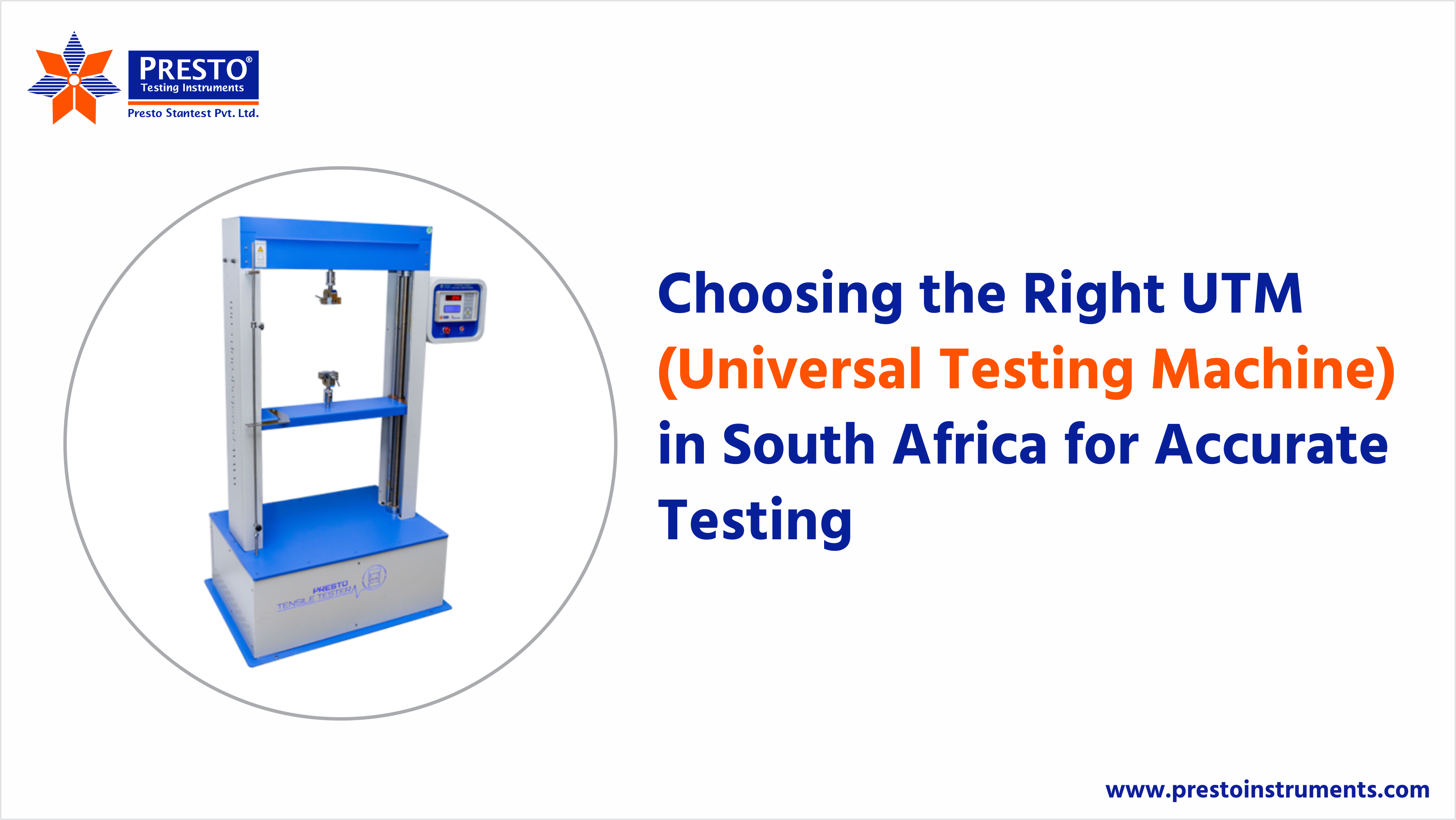
A UTM machine is laboratory equipment that is used to measure the mechanical properties of materials. It clamps a test sample and loads it in a slow and controlled manner. With the increase of the force, the machine measures such values as tensile strength, elongation, compression resistance, and breaking point.
The machine is called universal since it can do numerous types of tests on the same frame. Tension, compression, bending, and shear can be tested using the same unit by altering the fixtures and settings. UTM modern versions usually include computer programs or a digital display that transforms raw force readings into comprehensible graphs and reports. This transparency facilitates the comparisons of samples and the trend of quality over time in the labs.
Universal Testing Machines work according to globally accepted testing standards. These standards describe how samples should be prepared, how force must be applied, and how results should be measured. Commonly followed standards come from ASTM and ISO bodies. Each standard focuses on specific materials and test methods.
Universal Testing Machines follow established testing standards so that results stay consistent and accepted in technical work. These standards guide how samples are prepared, tested, and measured.
• ASTM D638
Used for plastic materials. It measures tensile strength, stretch during pulling, and stiffness of the sample.
• ASTM D412
Applied for rubber and elastomers. It focuses on breaking strength and elongation before failure.
• ASTM D1894
Used with plastic materials to measure the coefficient of friction, which shows surface sliding behavior.
• ASTM E8 and E8M
After treatment, to be followed by metal testing at room temperature. These are standards that determine the measurement of tensile strength, yield point, and elongation.
• Other supported standards
The machine is also in operation according to ASTM D429, ASTM D624, and ASTM D76. It is in line with IS 3400 on rubber testing and BS 2782 on testing plastic material.
A UTM machine has a number of basic components that interact with one another when testing:
There are several machines that have gone digital with PC based control panels. These systems enable the operator to establish the test speed, the load limits and the test duration. The outcomes are presented in the form of numbers and graphs. The storage options can have easy access to data that can be found later.
Other features that are included in some of the advanced models include:
These characteristics provide clarity and repeatability to test work, particularly in high-volume laboratories.
UTM machines come in variations according to the mode of load application and the capacity:
Electromechanical UTM machines: These are machines that are driven by a motor-powered screw and apply force. They are appropriate to test plastics, rubber, textiles, wires, and other such materials, where speed and accuracy have to be controlled.
Hydraulic UTM machines: These machines are machines that make use of hydraulic pressure to apply force. They are chosen for high-load testing such as metal bars, structural parts, and concrete samples. Their strength makes them suitable for heavy-duty work.
UTMs also vary by control style: Manual and digital models suit basic testing needs. Computerized models suit labs that need detailed data analysis, report creation, and test repeatability. The right type depends on the material range, test frequency, and reporting needs.
Load capacity: The machine must handle the maximum force your materials demand without strain. Over-sizing or under-sizing both create problems during testing.
Types of tests: There are labs that specialize in tensile tests and others that require compression, bending, or peel tests. Flexible fixtures allow a machine to have a broader test range.
Software and data handling: Clear display, simple controls, and easy report creation reduce operator effort. For labs working with audits or certifications, clean data records save time.
Service and calibration: A supplier with local support helps with routine checks, spare parts, and technical guidance. When comparing UTM Machine Price In South Africa, it helps to view the price alongside features, support, and expected service life rather than cost alone.
Presto Instruments has earned trust in material testing through years of experience and a consistent product range. The UTM machines from Presto Instruments cover different capacities and testing needs, from basic digital units to advanced computerized systems for universal testing machines.
These machines support common material tests and follow global testing norms. The control systems are designed for smooth operation and clear data display. Software options support test setup, live monitoring, and report creation in formats suited for labs and industries.
Presto Instruments also focuses on practical design. Stable frames, precise load measurement, and adaptable fixtures support long-term lab usage. Technical support and training help operators gain confidence in daily testing work. This balance of performance, usability, and support makes Presto a preferred choice among many Universal Testing Machine Suppliers in South Africa.
The choice of a Universal Testing Machine is a grave choice for any lab or industry. The machine directs the quality of the test data and determines product decisions. The UTM right in South Africa promotes compliance, research accuracy, and the development of products.
Buyers will be able to match the system to their testing requirements by understanding the types of machines, features, and standards in the market. In comparison of options and UTM Machine Price in South Africa, the performance, support, and long-term usability are some of the values. An effective UTM is an established element of routine testing activity and contributes to the reliable assessment of the material.
Faqs
Q. Which materials can be tested in a UTM machine?
Ans - UTM machines are used to test metals, plastics, rubber, textiles, wires, films and most composite materials based on capacity and fixtures.
Q. Is one UTM machine enough for different tests?
Ans - Yes. By changing grips and settings, a single machine can perform tensile, compression, bending, and shear tests.
Q. How often does a UTM machine need calibration?
Ans - Calibration is usually done once a year or as recommended by standards and lab practice to keep readings accurate.
Q. Does software come with UTM machines?
Ans - Many modern UTMs include software for test control, data display, and report generation.
Q. What affects the UTM Machine Price in South Africa?
Ans - Price depends on load capacity, control type, software features, build quality, and service support.
Elevate your quality assurance process to new heights
At Presto, we take pride in being Global manufacturers of Laboratory Testing Instruments for different industries.